
The dilemma isn't just financial. It's personal. Selling means walking away from something you built with your own hands, maybe for decades. Keeping means staying in the trenches, through burnout, market swings, and the daily grind of running a company.
Get this decision wrong, and the consequences are real: diminished enterprise value, missed market timing, or years of regret after an exit that came too soon or too late.
The numbers suggest most owners aren't prepared either way. Among baby boomer business owners surveyed in the Exit Planning Institute's 2025 generational report, 58% said they were likely to exit within five years, yet just 2% had a written transition plan in place.
This article breaks down both paths, when each makes sense, and how to decide with data instead of guesswork.
Key Takeaways
- Selling locks in liquidity and cuts operational risk; keeping compounds cash flow and future upside
- Get an objective, data-driven valuation before any hold-or-sell decision—not after
- Personal readiness (burnout, health, retirement plans) matters as much as the balance sheet
- Owner-dependent businesses sell for less; fixing that first often pays off
- Treat the business like it could sell tomorrow, whichever path you choose today
Selling vs. Keeping Your Business: Quick Comparison
Here's the trade-off in plain terms:
| Factor | Selling | Keeping |
|---|---|---|
| Liquidity | Converts equity into cash or diversified assets at closing | Generates ongoing distributions and salary, but wealth stays tied up |
| Daily stress | Relieves management burdens and liabilities | Requires continuous leadership and problem-solving |
| Risk exposure | Transfers market and operational risk to the buyer | Retains exposure to downturns and rising costs |
| Upside potential | Caps future gains at the sale price and earnout terms | Captures 100% of future appreciation |
| Control | Gives up authority over culture and direction | Maintains full control over vision and succession |
A buyer's offer often isn't just cash at closing. Many deals include seller financing, an earnout, or rollover equity. Those structures change your actual payout and future obligations, so weigh them carefully before assuming a sale means a clean, one-time check.
What Selling Your Business Involves
Selling converts years of sweat equity into immediate, liquid capital. Your business stops functioning as a daily job and turns into capital you can spend, invest, or pass down.
The core benefits of exiting include:
- Removes market risk and day-to-day operating risk
- Funding retirement or your next venture with a lump sum
- Personal freedom from daily management and liability
Sellers typically choose from a few transaction structures:
- Asset sale: the buyer purchases specific assets and generally assumes liabilities tied to those assets; you retain the rest
- Stock purchase: the buyer acquires your shares outright and takes on the company's existing assets and liabilities
- Equity recapitalization: a financial partner, often private equity, buys a stake so you get liquidity and may keep a minority position; control often shifts to the new partner
When Selling Makes the Most Sense
Some signals point clearly toward selling now rather than later:
- Burnout or health changes that make continuing untenable
- Retirement timelines that are already set in motion
- Peak performance: strong multi-year margins plus favorable M&A conditions that support premium valuation multiples
Timing matters because buyer appetite shifts. A business firing on all cylinders during an active M&A market commands a very different price than the same business sold during a lull.
One factor consistently works against sellers: owner dependence. M&A advisor Calder Capital notes that buyers evaluate whether earnings and client relationships will survive the owner's departure.
Heavy owner dependence usually means a lower offered multiple. Businesses with documented processes and a stable management team avoid that discount.
A certified appraisal sets that baseline before you go to market. At Mid Atlantic Business Brokers, valuations follow USPAP and NACVA standards and use asset-based, income-based, and market-based approaches to produce a defensible figure.

What Keeping and Growing Your Business Involves
Keeping means reinvesting cash flow into systems that scale, rather than cashing out today. It's a bet on your own upside.
The financial case for holding includes:
- Consistent dividend streams and ongoing income
- Tax advantages from operational write-offs
- Equity appreciation as the business grows
A common myth holds that keeping means staying chained to daily operations forever. It doesn't. Many owners install a general manager or professional leadership team and shift into a semi-absentee role, collecting income without running the business day-to-day.
When Keeping Makes the Most Sense
Keeping tends to outperform selling when:
- Operational bottlenecks exist that, if fixed over 12 to 36 months, would substantially lift EBITDA
- The market is temporarily soft: holding through an economic slump or tight capital markets avoids selling at a discount
- Customer concentration is too high — BizBuySell recommends keeping any single customer under 10% of revenue, since buyers price concentrated revenue as riskier
Diversifying your customer base before exiting, documenting systems, and building middle management don't just make the business run smoother. They directly change the multiple a buyer is willing to pay.
Selling vs. Keeping: Key Decision Factors to Guide Your Choice
A sound decision weighs three things together: your personal readiness, the business's salability, and current market health.
Personal readiness starts with financial dependence. Would sale proceeds, after capital gains taxes and transaction costs, actually support your post-exit lifestyle? Run the math before you assume selling solves your financial picture. If the net number falls short, holding and building value further may be the smarter move.
Salability hinges on owner expendability. Can the business function profitably without you walking through the door every morning? A simple gut check: could you take a 30-day vacation without the business suffering? If the honest answer is no, that's a valuation problem worth fixing, whether you plan to sell this year or five years from now.
Market health sets your timing. Strong buyer demand and solid multiples favor moving forward. Soft conditions usually mean waiting, or fixing valuation gaps first, rather than selling at a discount.
Those three checks typically point to one path:
- Sell now if you're burned out, financially ready, and the business is performing at or near peak margins
- Hold and build for 1 to 3 years if operational gaps, customer concentration, or messy financials are suppressing your valuation
- Wait out the market if conditions are temporarily soft but your underlying business is sound
Once you know the path, deal size shapes which valuation benchmarks apply. According to IBBA/M&A Source's Q2 2026 Market Pulse survey, larger transactions in the $5 million to $50 million range reported an average multiple of 5.8x EBITDA, a different earnings measure entirely from the SDE multiples used for smaller Main Street deals. Knowing which benchmark fits your business avoids comparing apples to oranges.

Real-World Business Crossroads: Case Studies and Strategic Transitions
Two owners hit the same sell-or-hold decision. Each chose a different path—and both got a strong outcome.
The sale: peak demand meets owner fatigue. The owner of an $11 million residential HVAC company chose to sell after years of strong demand left him ready for a change—and a planned move out of state. A confidential marketing process connected the business with a national industry consolidator.
The deal closed with continuity for employees and customers. He converted equity to cash while both company performance and the broader M&A market still favored sellers.
The hold: building value before the exit. A different owner chose to wait and strengthen the company first. Over 24 months, he:
- Cleaned up financial statements
- Built a middle-management layer
- Reduced customer concentration so no single client controlled the business’s fate
The result: a valuation multiple that roughly doubled from where it started.
Lessons from both:
- Clean, well-organized financials close deals faster and support stronger offers
- Reducing owner dependence and customer concentration directly lifts the multiple buyers will pay
- Timing the sale to market conditions, not just personal readiness, affects the final number

If you’re at the same fork in the road, a confidential valuation and exit assessment from Mid Atlantic Business Brokers can clarify what your business is worth today—and what a sell or hold path could look like—before you commit either way.
Conclusion
Selling or keeping isn't a permanent fork in the road. It's a strategic choice you can revisit as your circumstances, the market, and your business's performance evolve.
The smartest move, regardless of timeline: run your business as if it could sell tomorrow. Focus on:
- Clean, accurate books
- Management that runs without you day to day
- Cash flow a buyer can underwrite with confidence
Those habits pay off whether you exit next year or a decade from now.
Frequently Asked Questions
At what point should I sell my business?
The ideal time is when the business shows consistent profitability and growth, market conditions favor sellers, and you're personally and financially ready for what comes next. Waiting for all three to align beats rushing a sale during a downturn.
How much do companies usually sell for?
Small to mid-sized businesses typically sell for a multiple of Seller's Discretionary Earnings or EBITDA, depending on industry, revenue consistency, transferability, and asset backing. Multiples vary widely by sector and deal size.
What happens when I sell my company?
The transaction transfers ownership and assets to the buyer, settles outstanding obligations, and distributes net proceeds after taxes. Most deals also include a defined transition period where the seller trains the new owner.
Can I keep my business and step away from day-to-day operations?
Yes. Many owners hire capable management and document operational systems, shifting into an executive or semi-absentee role. This lets you keep ownership and upside while reducing daily involvement.
How do taxes impact the net proceeds from selling vs. keeping a business?
Selling triggers capital gains taxes, with the exact treatment depending on whether it's structured as an asset or stock sale. Keeping the business means ongoing exposure to ordinary income and distribution taxes instead.
How long does the process take if I decide to sell?
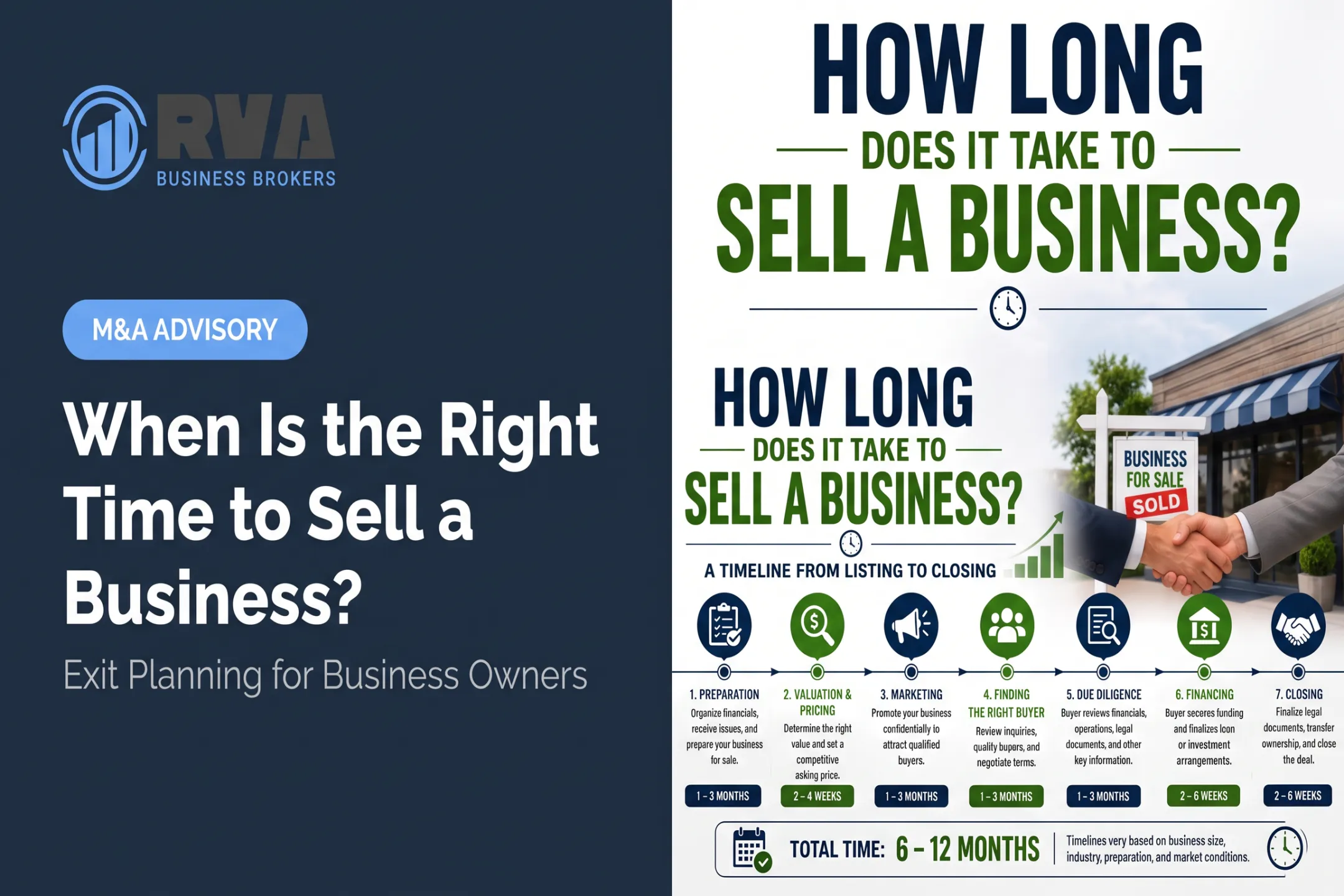
A typical confidential business sale process takes six to twelve months from initial valuation to closing. Larger or more complex transactions can take longer, depending on due diligence and financing timelines.