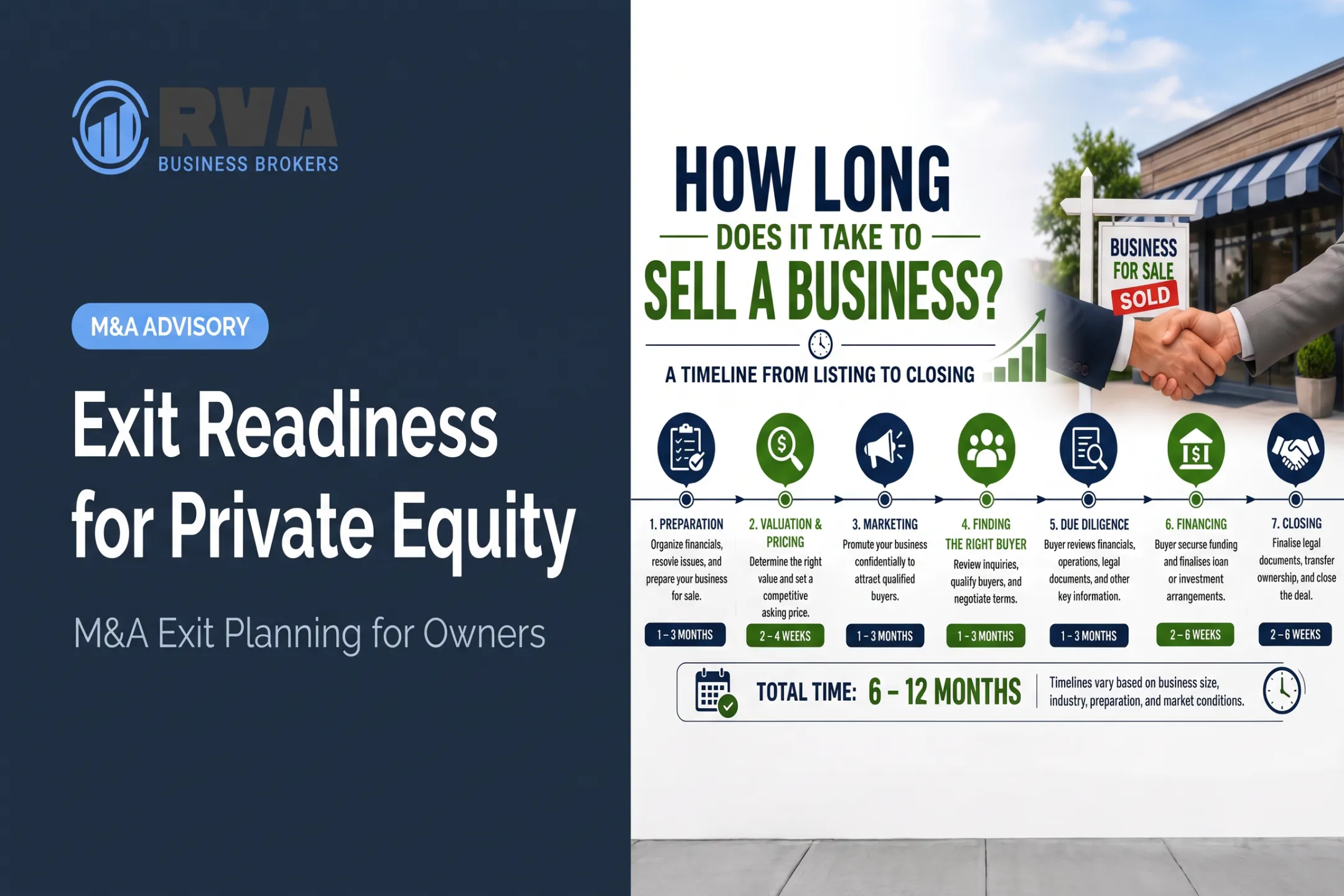

A PE sale isn't a simple trade of a business for a check. Your outcome depends on financial readiness, how well the buyer fits your goals, valuation methodology, deal structure, negotiating leverage, and what you expect from life after close.
This guide walks through the sale process step by step, what buyers expect to see before they'll talk price, the deal terms that determine your actual take-home, common problems that derail transactions, and the alternatives worth considering before you sign anything.
Key Takeaways
- PE deals run prep → outreach → LOI → diligence → final agreements → close
- Buyers score earnings quality, growth, management depth, and concentration risk—not revenue alone
- Rollover equity, earn-outs, and escrow holdbacks shape net proceeds beyond headline cash
- Firm track record, leverage habits, and governance style matter as much as price
- Assemble legal, tax, accounting, valuation, and sell-side advisors before you go to market
How to Sell Your Business to Private Equity
Step 1: Decide Whether PE Aligns With Your Exit Goals
Before you call a single buyer, get clear on what you actually want. Do you need a full exit, or are you open to staying on and growing the company alongside new capital?
Three paths produce very different outcomes:
- Full exit — you leave with cash and no further ties to the business
- Majority sale with continued involvement — you sell control but keep a role and a minority stake
- Minority recapitalization — you bring in a partner for growth capital while retaining control
Your business profile matters here too. A standalone company with scale and management depth may appeal as a platform investment. A smaller operation might only be attractive as an add-on to a PE firm's existing portfolio company. Knowing which category you fall into shapes who you approach and what terms to expect.

Step 2: Prepare the Business and Establish a Defensible Valuation
Buyers don't pay for potential they can't verify. Before you start conversations, pull together:
- Several years of financial statements and tax returns
- Customer and revenue breakdowns
- Debt schedules, budgets, and operating KPIs
Normalize your earnings next. Identify owner-specific expenses, one-time costs, and compensation adjustments, but document every single one. Buyers challenge add-backs they can't trace to source records.
Clean, accurate financials with documented add-backs tend to support stronger final pricing. An independent valuation or quality of earnings review before you go to market can surface weaknesses before a buyer finds them during diligence. That preparation gives you leverage instead of surprises.
Step 3: Identify and Approach Suitable PE Buyers Confidentially
Not every PE firm is a fit. Build a list based on industry focus, target company size, geography, investment thesis, and whether the firm is hunting for platforms or add-ons.
Keep the process staged:
- Share teaser information without identifying your company
- Require signed NDAs before releasing financials, customer data, or employee details
- Qualify buyer interest before granting access to sensitive materials
This is where a sell-side advisor earns their fee. Mid Atlantic Business Brokers supports owners through valuation, confidential marketing, buyer qualification, negotiation, and deal structuring. The work brings qualified buyers to the table while keeping employees, vendors, and competitors unaware of the sale until it closes.
Step 4: Move From Interest to a Signed Transaction
Once buyers engage, expect management calls, data requests, site visits, and potentially competing offers. Keep running the business normally. A dip in performance mid-process can spook a buyer or reopen pricing talks.
Review the Letter of Intent closely before signing. It should spell out:
- Valuation and purchase structure
- Exclusivity period and length
- Working capital expectations
- Financing assumptions and rollover equity terms
- Earn-out provisions and conditions to closing
Due diligence follows, typically 30 to 90 days. It covers financial, tax, legal, operational, HR, insurance, and customer-related risk.
Timing varies by deal size. In the IBBA/M&A Source's Q1 2026 survey of 203 closed transactions, LOI-to-close periods averaged roughly 4 months for $2M–$5M enterprise-value deals and 3 months for $5M–$50M deals.
Don't sign final purchase agreements until your legal, tax, and accounting advisors have reviewed the complete economics.

When Selling to Private Equity Makes Sense
PE is one exit route among several — strategic buyers, individual buyers, family offices, employee ownership, family succession, and management buyouts all compete for the same deals.
PE tends to fit owners who want:
- Meaningful liquidity now while keeping some equity for a second payday later
- Access to capital for expansion, acquisitions, or new markets
- Operational support from an experienced partner
- Help scaling beyond what the business could do alone
Watch for warning signs that PE isn't right for you. A PE sale will likely frustrate you more than it helps if you:
- Want a clean, immediate exit with no strings attached
- Refuse to share any control
- Can't stomach rigorous financial reporting and diligence demands
When comparing offers, look past the headline number. Weigh:
- Certainty of close
- Actual net proceeds after fees and escrow
- Ongoing obligations and governance terms
- How much leverage the buyer plans to load onto the business
- Cultural fit
- Your realistic shot at future upside
What You Need Before Approaching PE Buyers
Financial and Operational Readiness
Buyers want accurate, consistent records, not estimates. Assemble:
- Financial statements and tax filings
- Normalized earnings explanation
- Revenue by product or service line
- Customer concentration data
- A realistic forward forecast
No single customer should account for more than 10–15% of revenue. Businesses with subscription models or multi-year contracts often command a premium because recurring revenue reduces buyer risk.
Document your core processes too: pricing, sales, hiring, customer service, vendor management, and compliance. Ask yourself the vacation test: would the business run smoothly if you disappeared for 30 days? If not, close that gap before you go to market.
Legal, Tax, and Diligence Readiness
Organize everything a buyer's legal team will ask for:
- Corporate records and ownership documents
- Leases, customer and supplier contracts, intellectual property records
- Employee agreements, insurance policies, licenses, and permits
- Litigation history and regulatory materials
Flag unresolved tax, employment, environmental, or cybersecurity issues now, not after an LOI is signed. Work with an M&A attorney, CPA, tax advisor, and sell-side advisor. Assign ownership of each diligence workstream before requests start piling up.
Personal and Confidentiality Planning
Model your gross and estimated net proceeds with a personal advisor, accounting for taxes, rollover equity, and any deferred consideration. Know your retirement timeline and wealth needs before negotiations start, not during them.
Set an information-sharing protocol that protects trade secrets and employee confidentiality. Decide these points in advance:
- Minimum acceptable cash at close
- Rollover exposure you will tolerate
- Preferred post-close role
- Non-negotiable cultural priorities
Deal Terms and Variables That Affect Your Outcome
Two offers with identical headline enterprise values can produce very different checks after taxes, debt, escrow, and ongoing obligations are accounted for. Here's what actually moves the needle.
Valuation and Quality of Earnings
Buyers typically apply a multiple to sustainable EBITDA or another industry-relevant metric.
In GF Data's H1 2025 sample of 142 PE-backed transactions between $10M and $500M in enterprise value, average pricing came in around 7.2x trailing-twelve-month EBITDA. Companies with over 10% revenue growth and over 10% EBITDA margin earned roughly a 5% premium.
That's one market sample, not a universal number for every deal size. Ask your advisor what's realistic for your industry and revenue band.
Customer concentration, recurring revenue, margins, owner dependence, and management strength all swing the multiple up or down.
Deal Structure and Cash at Closing
An asset purchase and an equity purchase carry different tax consequences. Your CPA and tax attorney need to weigh in before you pick a structure.
Separate these terms clearly:
- Enterprise value: the agreed value of the operating business
- Equity value: what shareholders actually receive after debt and adjustments
- Working capital adjustment: a true-up against a negotiated baseline, not a payment for the entire balance
- Escrow and transaction expenses: amounts held back or deducted before you see cash
Rollover Equity and Future Upside
Sellers are often asked to reinvest part of their proceeds into the post-transaction company. Rollover equity has become more common: Goodwin's PE-deal database found it in 46% of middle-market transactions in 2020, rising to 57% in 2023.

Before agreeing, understand your ownership percentage, equity class, dilution risk, and whether your rollover sits on equal footing with the sponsor's investment. Ask how future acquisitions or new financing could affect your position down the line.
Earn-Outs, Seller Financing, and Holdbacks
Earn-outs tie part of your price to future performance metrics. Get specific on:
- Measurement periods and accounting rules
- Who controls operations during the earn-out window
- Dispute procedures if results are contested
- Remedies if the buyer changes how the business runs
Seller notes, indemnity escrow, and representations and warranties insurance each shift risk differently. Know what you're exposed to before you sign.
Post-Close Role, Governance, and Leverage
If you're staying on, nail down employment terms, compensation, restrictive covenants, board representation, and the conditions under which you could be replaced.
Also ask how much debt the buyer plans to put on the business. That leverage, plus the PE firm's exit timeline, can affect operations and your retained equity.
Common Problems, Alternatives, and How to Troubleshoot Them
Deal friction is normal. The key is catching warning signs before you sign an LOI or enter exclusivity.
Common Problems and What to Check
- Buyers challenge your earnings adjustments — trace every add-back to source documents and separate recurring items from one-time costs
- Diligence requests overwhelm your team — build a document index, assign an owner to each request, and keep running the business normally
- The offer changes mid-diligence — compare the revised valuation, working capital assumptions, and risk allocation against the original LOI before deciding whether to proceed
Alternatives to a PE Sale
PE isn't the only path. Consider:
- Strategic buyers — typically integrate your business into theirs rather than running it as a standalone portfolio company
- Management buyouts — existing leadership buys in, though financing access is often the limiting factor
- Employee ownership — an ESOP or direct equity grant shifts both control and economics to your team
- Family succession — passes ownership to the next generation instead of going to an outside buyer
A real-world example: one Virginia-based HVAC company generating $11 million in annual revenue sold to a strategic national buyer after the owner prioritized finding the "right buyer" over simply taking the highest offer. The deal retained roughly 30 employees and let the owner relocate to Florida with a smooth transition.
If a clean exit, employee continuity, or a simpler transaction matters more to you than growth capital and rollover upside, these alternatives may serve you better. A competitive process that compares PE and non-PE buyers side by side often preserves the most negotiating leverage either way.
Conclusion
Selling to private equity works best when your business is financially credible, operationally transferable, and matched with a buyer whose strategy fits your goals. Preparation has to cover more than your asking price.
Factors that decide whether the deal delivers include:
- Valuation quality and clean financial records
- Management depth and operational transferability
- Legal readiness and confidentiality controls
- Personal financial planning before you sign
- Terms of your post-close role and relationship
Mid Atlantic Business Brokers has spent more than 40 years helping business owners across Virginia, Washington D.C., Maryland, the Carolinas, Georgia and Florida work through these questions, using Certified Business Appraisers and valuation practices aligned with USPAP standards. If you're weighing a PE sale against other exit paths, a confidential valuation and sell-side consultation is a strong place to start.
Frequently Asked Questions
How do I sell my business to a private equity firm?
Start with preparation and a defensible valuation, then move through confidential buyer outreach, LOI negotiation, due diligence, and definitive agreements. Qualified legal, tax, accounting, and transaction advisors should be involved at every stage.
What happens when a company is sold to a private equity firm?
Ownership and governance shift, often with the seller retaining rollover equity and a defined post-close role. The PE firm typically pursues growth initiatives before exiting the investment in three to seven years.
Is selling to private equity worth it?
It depends on your goals, the valuation offered, your net proceeds after obligations, and your tolerance for reduced control and intensive diligence. There's no single right answer. Fit matters as much as the financial outcome.
What does private equity look for in a business?
Sustainable earnings, growth potential, recurring or defensible revenue, capable management that isn't dependent on the owner, transferable operations, and manageable legal or financial risk.
How long does it take to sell a business to private equity?
Timing varies with readiness, buyer interest, and diligence complexity, but most private business sales take 6 to 12 months from going to market to close. Ask your deal team for a timeline specific to your transaction.
Do I need an advisor to sell my business to private equity?
Yes. Coordinated M&A, legal, accounting, tax, and valuation advice helps level the playing field against sophisticated buyers. The exact advisory team depends on your deal's size and complexity.