
This guide is for U.S. business owners considering retirement, a strategic exit, a partial sale, or a transition away from day-to-day operations. That includes service, healthcare, construction, remodeling, food, manufacturing, and technology businesses of all sizes.
Understanding the process matters because sellers have to protect confidentiality, set realistic expectations, and prepare for buyer scrutiny. Nearly 58% of baby-boomer business owners plan to exit within five years, according to the Exit Planning Institute's 2025 Generational Report — yet most haven't built a formal plan to get there.
This article walks through the stages that move a business from "for sale" to "sold," the factors that actually drive price, and when a full marketed sale isn't the right fit.
Key Takeaways
- The process moves from exit planning and valuation through preparation, confidential outreach, offers, due diligence, final agreements, and transition.
- Sale price depends on sustainable earnings, market conditions, buyer demand, and deal structure, not revenue alone.
- Confidentiality requires controlled information release, qualified buyers, and properly timed NDAs.
- Highest offer isn't always best; financing certainty and terms matter equally.
- Timelines, multiples, and transaction data vary widely by deal size and source — treat any single statistic with caution.
What Is the Company Selling Process?
The company selling process is the coordinated set of financial, operational, marketing, legal, and negotiation activities that transfer ownership from a seller to a buyer. It connects planning, pricing, marketing, and legal execution into one sequence rather than treating them as separate events.
The goal is simple to state, harder to execute: achieve an acceptable price and structure, protect the business during the sale, satisfy legal and financial requirements, and complete an orderly transition.
It helps to separate three terms that often get blurred:
- Valuation: estimates what the business is worth
- Marketing/listing: creates buyer interest and generates offers
- Closing: the legal act of transferring ownership
The full selling process connects all three, plus everything that happens in between.
Why Business Owners Use a Structured Selling Process
A structured process forces clarity. It helps owners define what they actually want: maximizing proceeds, protecting employees, preserving a legacy, or simply reducing personal involvement before retirement.
Without a plan, things go wrong in predictable ways:
- Premature disclosure to employees, competitors, or customers
- Unrealistic pricing that scares off serious buyers
- Incomplete financial records that stall diligence
- Weak buyer qualification, wasting months on unqualified prospects
- Renegotiation after terms were already "agreed"
- A deal that collapses near closing
The process also isn't one-size-fits-all. An owner-operated HVAC company, a regulated healthcare provider, and a $7 million manufacturer will need different levels of preparation, legal review, and financing structure.
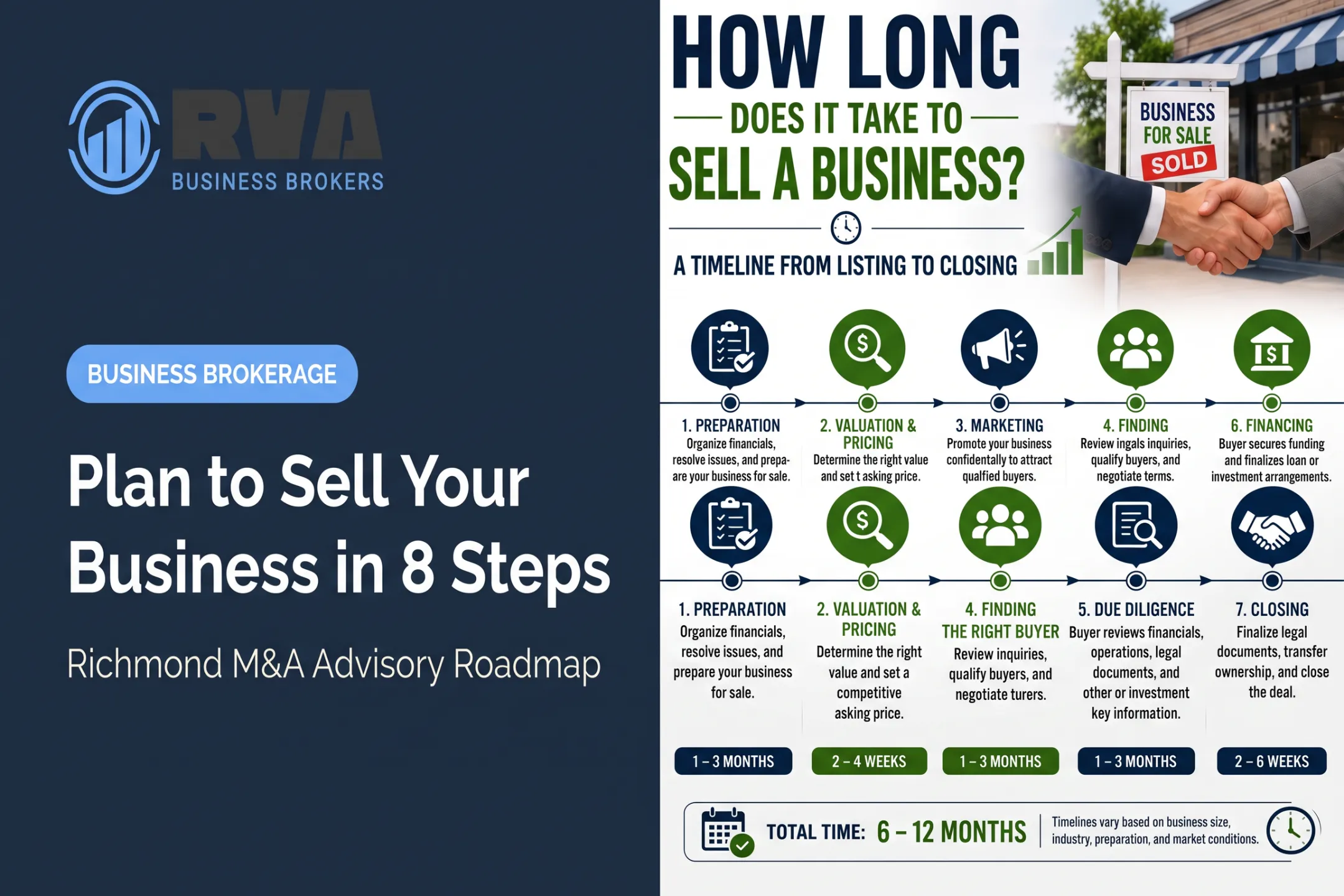
Timelines shift accordingly. IBBA and M&A Source's Q2 2026 Market Pulse survey reports an average of 6 to 10 months from engagement to close for Main Street transactions. Lower-middle-market deals average 11 to 12 months. These are survey averages across many transactions, not a guarantee for any one sale.

How Does the Company Selling Process Work?
The process runs from seller goals and preparation, through valuation and confidential marketing, to buyer qualification, offers, due diligence, purchase agreements, closing, and post-closing transition.
Buyers will want to see financial statements and tax returns, owner compensation and add-backs, customer and supplier details, contracts, licenses, leases, intellectual property, employee information, inventory, and equipment. The seller's preferred timeline and terms shape how all of this gets presented.
Control comes from confidentiality agreements, staged information release, buyer screening, a secure data room, documented financial adjustments, and clear negotiation milestones.
Step 1: Clarify Goals and Assemble the Deal Team
Before going to market, define the desired outcome: timing, acceptable post-closing involvement, preferred buyer type, and minimum financial or non-financial requirements.
A typical deal team includes:
- A business broker or M&A advisor
- A transaction attorney
- A tax advisor and accountant
- A valuation professional
- A lender (for buyer financing support)
Legal and tax professionals should advise on transaction-specific decisions. This is not a do-it-yourself area once real money is on the table.
Step 2: Prepare the Business and Review Financial Information
Buyers commonly request several years of financial statements and tax returns, current-year results, balance-sheet information, debt schedules, customer concentration data, contracts, leases, licenses, and employee records.
Preparation work that matters most:
- Reconcile the books and document owner-specific or one-time expenses
- Separate personal and business expenses that have blended over the years
- Resolve tax or compliance issues before a buyer's accountant finds them
- Reduce owner dependence by documenting recurring processes
- Address customer or supplier concentration where one relationship carries too much weight
Buyers typically ask for the last three years of tax returns as a baseline. Anything missing or inconsistent raises questions before the deal even starts.
Step 3: Establish a Defensible Valuation and Asking-Price Strategy
Valuation can draw on three approaches: asset-based (assets minus liabilities), income-based (cash flow converted to present value), and market-based (comparable transactions). Most credible valuations weigh all three against industry conditions, growth prospects, and risk.
Four numbers often get confused:
| Term | What it represents |
|---|---|
| Estimated value | What a valuation analysis suggests the business is worth |
| Asking price | What the seller lists the business for |
| Negotiated purchase price | What the buyer actually agrees to pay |
| Net proceeds | What the seller keeps after debt, fees, taxes, and adjustments |
An unrealistic asking price slows everything down. Buyer interest fades, the listing sits, and sellers often end up re-pricing anyway, having lost momentum in the process. A properly supported price does the opposite: it builds credibility and strengthens negotiating leverage from the first conversation.
Mid Atlantic Business Brokers builds valuations from financial statements, tax returns, cash flow, and industry benchmarks, applying asset-based, income-based, and market-based methods guided by USPAP and NACVA standards. Founder Dan Daniel, a former CPA, has applied this approach across retail, healthcare, manufacturing, and technology transactions for more than 40 years.
Step 4: Create Confidential Marketing Materials and Approach Buyers
Marketing typically moves in stages:
- Anonymous teaser: a one-page summary with no identifying details
- Confidential information memorandum (CIM): a fuller profile shared after a signed NDA
- Secure data room: detailed financials and records released to qualified buyers only
NDAs, buyer registration, and financial-capability checks protect employees, customers, suppliers, and competitive information until a buyer proves they're serious.
Buyer categories differ in what they bring to the table:
- Individual buyers: often owner-operators seeking a career change
- Strategic acquirers: competitors or adjacent businesses seeking synergies
- Private equity groups: financial buyers focused on growth and exit multiples
- Competitors: require the most cautious disclosure timing
The right buyer depends on the seller's goals, desired deal structure, and how much transition support the business needs.
Step 5: Evaluate Offers, Negotiate an LOI, and Complete Due Diligence
Comparing offers means looking past the headline number to cash at closing, seller financing, earn-outs, contingencies, financing risk, and the buyer's actual ability to close.
A letter of intent (LOI) outlines the major commercial terms (price, structure, and key conditions) ahead of the definitive purchase agreement. It's preliminary, though some provisions (like exclusivity) can be binding. Legal review before signing is non-negotiable, because binding terms vary deal to deal.
Due diligence then tests everything: financial, tax, legal, commercial, operational, regulatory, HR, technology, and environmental factors, depending on the business. Findings here can change price, warranties, or closing conditions.
This stage carries real risk. Axial's analysis of 75 failed transactions found that 25.3% involved non-quality-of-earnings diligence findings and 21.3% involved quality-of-earnings or EBITDA discrepancies, according to its Dead Deal Report. That's a sample of failures, not a failure rate for every signed LOI, but it shows exactly where deals break down.
Keeping records consistent, responding promptly, and disclosing known issues early all help preserve momentum through this stage.
Step 6: Negotiate Final Documents, Close, and Transition Ownership
The purchase agreement covers representations and warranties, indemnities, purchase-price adjustments, non-compete provisions where enforceable, escrow terms, seller notes, and any post-closing employment or consulting arrangements.
Closing itself follows a sequence: satisfy conditions, obtain required consents, execute documents, transfer funds and ownership, and deliver assets or records.
Transition planning covers employees, customers, vendors, licenses, systems, and institutional knowledge. The seller's ongoing role, whether that's 30 days of consulting or a year of transition support, needs to be defined in writing, not assumed.

Common Issues and Misconceptions
A few misunderstandings cause the most friction during a sale.
Asking price ≠ sale price. Buyer demand, proof of earnings, perceived risk, and financing availability shape the final number far more than the list price does.
Marketing without confidentiality is risky. Revealing a company's identity before screening buyers can alarm employees, spook customers, or tip off competitors long before a deal is close.
Keep these financial terms straight:
- Revenue — total sales before expenses
- Profit/net income — earnings after expenses and taxes
- Cash flow or SDE — owner-adjusted earnings common in small-business listings
- EBITDA — earnings before interest, taxes, depreciation, and amortization
- Enterprise value vs. equity value — debt and working-capital adjustments change what the seller actually receives
LOI ≠ closed deal. Due diligence, financing, consents, and closing conditions can still change terms or end the deal entirely.
Common seller mistakes worth avoiding:
- Waiting until an exit becomes urgent (health, burnout, partner dispute)
- Mixing personal and business expenses for years
- Relying on an unsupported valuation multiple from a competitor's sale
- Withholding known problems until diligence surfaces them anyway
- Contacting competitors or employees before buyers are qualified
- Skipping post-sale transition planning entirely
Tax treatment, restrictive covenants, and regulatory approvals vary by state and transaction. A qualified attorney and tax advisor should weigh in before terms are finalized.
When May This Process Not Be Appropriate?
A full marketed sale isn't always the right move. Several alternatives may fit better:
- Family transfer — passing the business to a relative
- Management or partner buyout — existing leadership or co-owners acquire the company
- Internal succession or ESOP — an employee stock ownership plan, where employees gain ownership over time
- Direct sale to a known strategic buyer — skipping broad marketing when a buyer is already identified
Each of these still requires valuation, legal review, tax planning, and financing — they just skip the confidential marketing stage.
An immediate sale can also be inefficient when:
- Ownership disputes remain unresolved
- Financial records are incomplete or inconsistent
- Performance is declining without a clear explanation
- Contracts or licenses aren't transferable
- Daily operations still depend entirely on the owner
- Legal or tax issues haven't been addressed
In some cases, a partial sale, recapitalization, merger, or phased transition better matches your financial and personal goals than a complete exit.

Signals that it's time to pause and prepare rather than list the business:
- You can't clearly explain your own financial performance
- Asset or IP ownership is unclear
- There's no transition plan for key relationships
- Proceeds expectations don't match market reality
- You're unwilling to share the records diligence will require
A confidential consultation with Mid Atlantic Business Brokers can help you assess readiness, understand likely value, and compare exit options before formally taking the company to market.
Conclusion
The company selling process is a staged transaction: preparation, valuation, confidential outreach, negotiation, due diligence, legal documentation, closing, and transition. Each stage feeds into the next.
Accurate information, realistic expectations, and early preparation reduce avoidable friction later. Confidentiality protects the business while it's still operating.
Before you signal publicly that the business is for sale:
- Clarify your exit goals
- Organize your core financial records
- Seek confidential guidance from a qualified advisor
Frequently Asked Questions
What are the 7 steps of the selling process?
The process typically runs: define goals and prepare, value the business, create marketing materials, confidentially identify and qualify buyers, evaluate offers and sign a letter of intent (LOI), complete due diligence and final agreements, then close and transition ownership.
How do I price a company to sell?
Pricing should reflect sustainable earnings, assets, liabilities, market conditions, comparable transactions, and buyer demand. A professional valuation supports that figure better than revenue alone.
What is the best way to sell my company?
It depends on company size, industry, owner goals, and transaction complexity. A structured, broker-led process typically helps with valuation, qualified buyers, negotiation, and closing.
What is the best time of year to sell a business?
Readiness, financial performance, and market conditions matter more than the calendar. Prepare well in advance and research current industry conditions before launching a sale.