
This guide is written for owners of offset, digital, wide-format, finishing, mailing, and fulfillment operations. Preparation matters because it directly affects value, confidentiality, and whether the business keeps running smoothly during the transition.
Many owners assume a sale comes down to equipment and revenue. It doesn't. Buyers also evaluate your customers, contracts, employees, systems, margins, and how dependent the business is on you personally.
This article covers how the sale process works, what drives value, which documents buyers expect, and when professional guidance makes sense.
Key Takeaways
- Buyers price both hard assets and a going concern with cash flow and customer relationships
- Clean records, documented equipment condition, and reduced owner dependence build buyer confidence
- Confidentiality requires staged disclosures, NDAs, and qualified-buyer screening
- Individuals, competitors, strategics, and investment groups each underwrite the deal differently
- Start preparation early: valuation, buyer sourcing, and transition planning all take time
What Is the Process of Selling a Commercial Printing Business?
Selling a commercial printing business means preparing the company, establishing value, finding qualified buyers, and transferring ownership without breaking customer or production continuity. Done well, the seller receives the agreed purchase price, and the buyer steps into an operation that keeps serving accounts and generating revenue.
That path differs from liquidating equipment. A going-concern sale can include:
- Presses, finishing, and mailing equipment
- Inventory and intellectual property
- Customer relationships and active contracts
- Goodwill and brand reputation
- Trained workforce and management
- Operating systems, estimating procedures, and production workflows
Most successful sales follow the same sequence:
- Prepare the business — Clean financials, document workflows, and reduce owner-only dependencies so diligence is straightforward.
- Establish value — Build a defensible valuation from earnings, assets, and comparable printing sales.
- Market confidentially — Reach qualified buyers under NDA without tipping off staff, customers, or competitors.
- Negotiate and structure — Align price, working capital, leases, liabilities, and seller transition support.
- Close and hand off — Transfer ownership, contracts, and know-how so production and service continue without interruption.

Valuation is not the same as asking price. A valuation estimates what the business is worth based on earnings, assets, and comparable sales. The negotiated price still moves with deal terms, including:
- Financing structure and lender requirements
- Working capital delivered at closing
- Assumed liabilities and equipment leases
- Scope and length of seller transition support
- Buyer motive (capacity, customers, geography, or tuck-in talent)
A Richmond example shows the difference in practice. In 2026, Worth Higgins & Associates acquired the assets and business of B&B Printing—not only the machines, but customer accounts, intellectual property, and B&B’s sales and support team, who joined the buyer. The transfer protected continuity because the sale moved the operating business, not a pile of idle equipment.
How the Sale Process Works
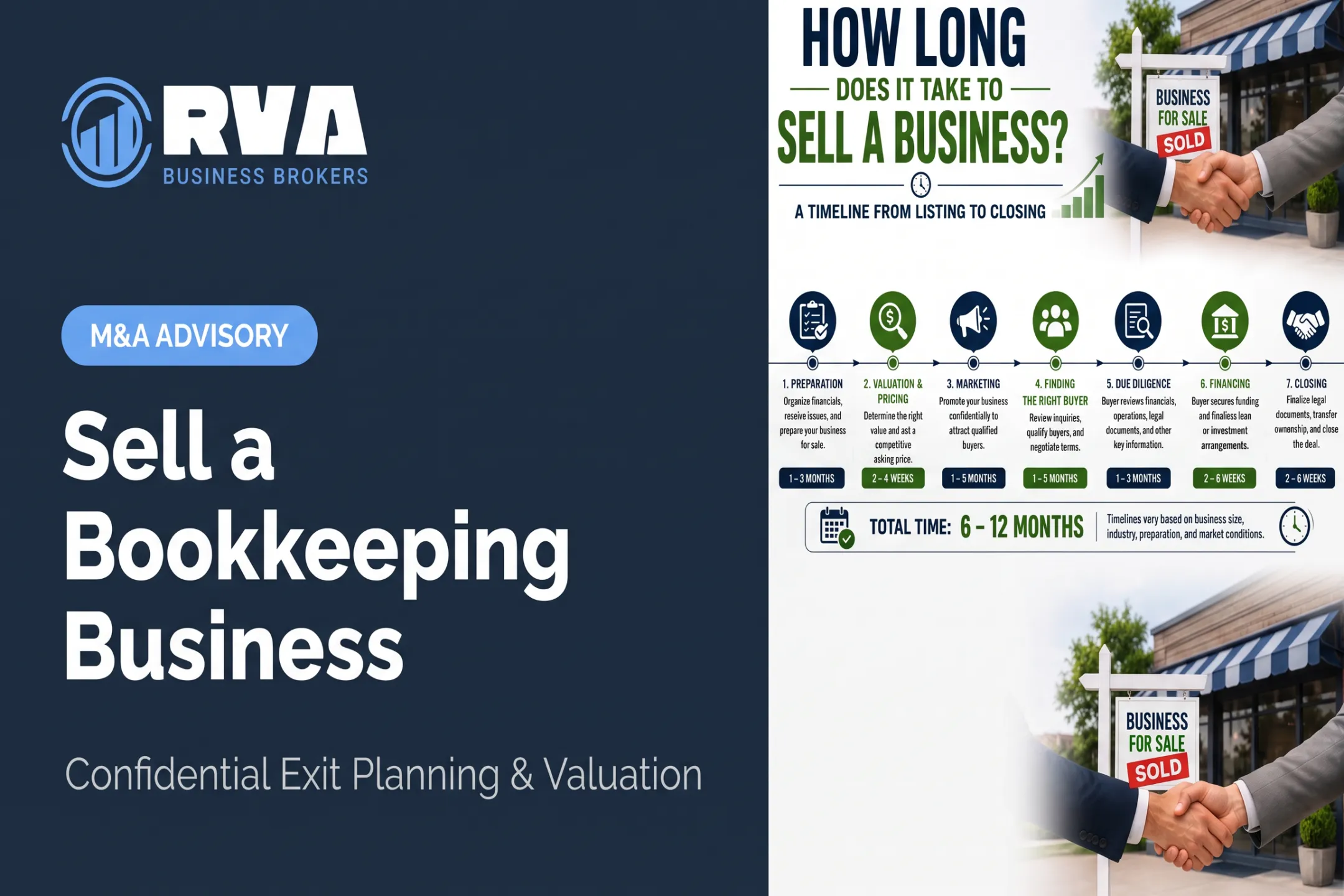
A commercial printing sale moves through five stages: readiness assessment, valuation, confidential marketing and buyer qualification, diligence and negotiation, and closing with transition support. Each stage requires specific information:
- Financial statements and tax returns
- Equipment schedules and facility details
- Customer data, contracts, and leases
- Employee records, licenses, and insurance documentation
Buyers use this information to test one core question: can this business sustain its earnings without you? They'll inspect equipment and facilities, review customer retention and concentration, assess production capacity, and flag anything that could affect price or deal terms.
Confidentiality agreements, staged disclosure, and a secure data room control who sees what and when. As the deal progresses, an initial valuation range becomes a letter of intent, which becomes a definitive purchase agreement with negotiated price, structure, and closing conditions.
Timing matters here. The IBBA/M&A Source Market Pulse report found that businesses took an average of 7 to 10 months to close, depending on the price band, across Q4 2025 transactions — figures that apply broadly to small-business sales, not printers specifically.
| Purchase-price band | Average months to close |
|---|---|
| Below $500K | 10 |
| $500K–$1M | 9 |
| $1M–$2M | 7 |
| $2M–$5M | 9 |
| $5M–$50M | 8 |

About three to four of those months typically happen after a signed letter of intent. Don't wait until the week you decide to sell to start preparing your records.
Step 1: Prepare the Business and Owner
Before anything goes to market, clarify your own goals. Why are you selling? What's your timeline? Will you stay on for transition training, or do you want a clean break? Buyers ask these questions early, and vague answers slow everything down.
Step 2: Establish Value and Sale Positioning
Organize three years of financial and operating records, select the right valuation approach, and build an honest profile of the company's strengths and risks. A Certified Business Appraiser earns their fee here: a defensible number protects you in negotiations.
Step 3: Market Confidentially and Qualify Buyers
Present the opportunity without unnecessarily revealing the company's identity. Require NDAs before sharing sensitive details, and prioritize buyers who have both the financial capacity and operational fit to actually close.
Step 4: Complete Diligence and Negotiate
Equipment condition, lease terms, and customer concentration get tested line by line. Expect buyer questions on job costing, backlog, and margin sustainability. Bringing in accounting and legal professionals here protects you from surprises.
Step 5: Close and Transition
Ownership of equipment, employees, customer relationships, systems, and records transfers according to the purchase agreement. Many deals include an agreed transition period where the seller provides training or customer introductions.
Key Factors That Affect Sale Value
Buyers evaluate a commercial printer across several dimensions at once. These factors most often shape price, terms, and buyer confidence:
- Financial performance — Multi-year P&Ls, tax returns, cash flow, add-backs, job costing, margins, backlog, and working-capital needs.
- Revenue quality — Recurring orders, print-management contracts, and diversified accounts signal lower risk than concentrated one-off work.
- Service mix and capacity — Offset, digital, wide-format, finishing, mailing, fulfillment, and packaging — plus how in-house vs. outsourced work affects margins.
- Equipment and technology — Make, model, age, utilization, lease vs. ownership, maintenance history, and MIS/ERP or web-to-print fit.
- Workforce and independence — Trained staff, cross-coverage, and documented estimating so the shop runs without the owner on every job.
- Market position and upside — Customer segments, reach, online ordering, and expansion paths backed by evidence—not optimistic forecasts.
- Risk and compliance — Customer concentration, environmental and chemical handling, safety, insurance, permits, and supplier dependencies.
Why a Professional Valuation Matters
Those factors only translate into a credible asking price when someone weighs them together. A rule of thumb is a reasonableness check, not a stand-alone valuation method under NACVA guidance. Professional judgment decides which approach—asset-based, income-based, or market-based—fits your shop.
Mid Atlantic Business Brokers builds valuations aligned with USPAP and NACVA standards, reconciling all three approaches against your actual records. That gives sellers a defensible starting point for pricing, buyer conversations, and diligence—not a generic industry multiple.
Common Issues and Misconceptions
Several assumptions trip up sellers before they even get to the negotiating table.
"Our presses cost a fortune, so the business is worth that much." Equipment cost doesn't establish enterprise value. Obsolete, underutilized, heavily financed, or overly specialized equipment can add far less value than owners expect. Sometimes it adds none at all if replacement is already due.
"Our revenue is strong, so our price should be too." Buyers care about sustainable cash flow, margins, and working capital, not top-line sales. A 2025 PRINTING United Alliance survey of 83 commercial printers found 42.2% reported lower pre-tax profitability over the first three quarters, even with modest average sales growth. Revenue and profit are not the same story.

"We'll just tell everyone we're selling." Immediate, unmanaged disclosure can spook employees, customers, and vendors, and it can weaken your negotiating position. A staged, confidential process protects all three.
Other red flags that create diligence friction:
- Heavy owner dependence with no documented processes
- Weak or inconsistent job costing
- Customer concentration in one or two accounts
- Informal subcontracting arrangements
- Unclear or unfavorable equipment leases
Some owners also chase an unrealistic asking price by leaning on replacement cost, skipping expense normalization, or ignoring upcoming capital investment.
If those issues show up in your shop, pause before a full sale and tighten the business first:
- Build a basic exit plan and timeline
- Clean up financial reporting and job costing
- Reduce owner dependence with documented processes
- Restructure equipment debt where it drags value
Conclusion
Selling a commercial printing business takes more than listing your presses. Buyers look for proof they can verify:
- Credible financial performance
- Durable customer relationships
- Capable employees and documented systems
- A realistic growth story
Starting early gives you room to decide: sell now, improve the business first, pursue a strategic buyer, or consider another exit route entirely.
Mid Atlantic Business Brokers has guided Virginia business owners through valuations, exit planning, and confidential sales for over 40 years. Our team includes Certified Business Appraisers working under USPAP-aligned standards. No valuation can guarantee a specific sale price or outcome.
If you're ready to explore a sale or want a clearer read on value first, request a confidential consultation. Call 804-614-4645 or email dan@rvabusinessbrokers.com.
Frequently Asked Questions
Is a printing business profitable?
Profitability depends on service mix, pricing, equipment utilization, recurring demand, and overhead control. Results are company-specific, and profitability is not the same measure as sale value.
Is print-on-demand still profitable in 2026?
Print-on-demand is an asset-light model, different from a commercial printing company with presses, finishing, and fulfillment capacity. Its profitability varies by niche and fulfillment costs, so it shouldn't be used as a benchmark for valuing a commercial printer.
How much is my commercial printing business worth?
Value depends on sustainable earnings, equipment condition, customer concentration, contracts, workforce, and liabilities. A professional valuation using asset-based, income-based, and market-based approaches gives a far more defensible answer than an unsupported industry multiple.
How long does it take to sell a commercial printing business?
Timing varies with readiness, buyer demand, financing, and transaction complexity. Industry data points to roughly 7 to 10 months for small-business sales generally, so starting preparation early matters more than hitting a specific deadline.
How can I sell my printing business confidentially?
Confidentiality relies on qualified-buyer screening, signed NDAs before sharing sensitive data, limited or anonymous initial marketing, and staged information release. Communication with employees and customers should be carefully timed, not immediate.
What documents do I need to sell a commercial printing company?
You'll need three years of financial statements and tax returns, equipment schedules and maintenance records, customer and revenue data, leases and contracts, employee records, insurance and licenses, and documentation of outstanding liabilities.