
That gap between what an owner expects and what a buyer will actually pay explains why so many service-business sales stall or close below hoped-for numbers. Revenue alone doesn't set price. Neither does personal effort or a number copied from a "businesses for sale" listing down the street.
This article breaks down what actually moves the needle: preparing the business before it reaches market, getting a defensible valuation instead of a guess, running a confidential and competitive sale process, weighing the full offer rather than just the sticker price, and sidestepping the mistakes that quietly shave dollars off a deal.
Key Takeaways
- Sustainable cash flow, low owner dependence, diversified customers, and recurring revenue drive price more than top-line sales.
- A professional valuation, not an online multiple, establishes a realistic and defensible range.
- Organized financial, legal, and operational records speed diligence and protect negotiating leverage.
- Judge offers by cash at closing, financing certainty, earnouts, and terms, not price alone.
- Confidentiality and steady performance during the sale keep buyer interest from cooling.
How to Prepare a Service Business to Command a Higher Price
Start With a Buyer-Focused Readiness Assessment
Look at your business the way a buyer will: what produces income that doesn't depend on luck, and what would make an acquirer hesitate?
Work through these questions:
- Which customers, contracts, or referral sources generate the most reliable revenue?
- What could disrupt operations in the first 90 days of new ownership?
- Where does the owner's personal involvement create a single point of failure?
- Are licenses, supplier relationships, and staff capability solid enough to survive a transition?
Turn the answers into a prioritized improvement plan. Favor changes that show up in your financials or reduce buyer risk over cosmetic fixes nobody pays extra for.
Strengthen Financial Records and Earnings Quality
Buyers and their advisers want to reconcile the story behind your numbers, not take your word for it. Before listing, organize:
- Three to five years of tax returns, profit-and-loss statements, and balance sheets
- Bank records, payroll data, and cash-flow reports
- Supporting schedules for every recurring expense
Separate personal, unusual, or one-time costs from normal operating expenses, but document each proposed add-back with records a buyer can verify. A travel expense only holds up as "discretionary" if a new owner genuinely won't incur it.
Many buyers now commission a quality-of-earnings review, which tests whether reported profit will actually continue after the sale. Expect that scrutiny and prepare for it rather than reacting to it mid-negotiation.
Build Recurring, Diversified, and Transferable Revenue
Predictable revenue lowers buyer risk, and lower risk supports a higher multiple. Map your revenue by:
- Recurring contracts and maintenance agreements versus one-time project work
- Customer concentration, ideally with no single client above 10-15% of revenue
- Contract length, renewal history, and backlog
- Referral sources and how dependent they are on the owner personally
In Virginia's current market, businesses with subscription models or multi-year service agreements often command a premium over comparable firms selling purely transactional work.
For regulated or specialized services, such as healthcare or disability support agencies, document licenses, payer contracts, waivers, and any restrictions on transferring them. A buyer who can't confirm continuity of a Medicaid waiver, for instance, will discount the offer accordingly.

Reduce Owner Dependence and Document Operations
Ask yourself honestly: if you took a 30-day vacation, would the business run smoothly without you? If the answer is no, that's exactly what a buyer will worry about.
Steps that help:
- Transfer key customer and supplier relationships to managers or account leads
- Document sales, scheduling, billing, quality control, and compliance procedures in an operations manual
- Cross-train employees and establish delegated decision-making
- Build a management team capable of running day-to-day operations
A business that doesn't need its owner is easier, and less risky, for a buyer to operate after closing.
Position the Business's Intangible Assets
Cash flow isn't the only thing buyers pay for. Catalog your intangible assets:
- Brand reputation, online reviews, and local market position
- Website, marketing channels, and customer data, handled lawfully
- Proprietary processes, trade names, and intellectual property
- Referral relationships and a defensible service niche
Verifiable evidence matters more than claims. A strong review count only strengthens buyer confidence if it's tied to service quality they can confirm independently.
This is also where a confidential, data-driven valuation earns its keep. Mid Atlantic Business Brokers builds pre-sale planning around USPAP-aligned analysis and Certified Business Appraisers. The goal is to help owners identify which intangible assets actually matter before a single buyer sees the business, without promising a specific sale price.
How to Value a Service Business and Set the Price
Understand What Buyers Are Actually Paying For
Several terms get used interchangeably, but they mean different things:
- Revenue – total sales, before any costs
- Seller's Discretionary Earnings (SDE) – pretax profit recast for owner compensation and discretionary expenses, typical for owner-operated businesses
- Adjusted EBITDA – earnings before interest, taxes, depreciation, and amortization, used more often above roughly $2 million in purchase price
- Enterprise value vs. equity value – what's being acquired versus what the seller nets after debt
- Net proceeds – what lands in the seller's account after taxes, fees, and adjustments
Which metric applies depends on business size, management depth, and how involved the buyer expects to be after closing.
Use Multiple Valuation Approaches
A defensible valuation rarely relies on one formula. The National Association of Certified Valuators and Analysts recognizes three core approaches, often used in combination:
- Income approach – converts sustainable cash flow into a value using a market-derived multiple or capitalization rate
- Market approach – compares the business to actual sales of similar companies, adjusted for size, geography, growth, and risk
- Asset approach – values assets less liabilities; more relevant for asset-heavy operations, distressed businesses, or companies whose earnings don't support a going-concern premium
| Approach | Best suited for |
|---|---|
| Income | Established businesses with stable, recurring cash flow |
| Market | Businesses with comparable transaction data available |
| Asset | Asset-heavy, distressed, or low-earnings situations |
No single approach tells the whole story. A credible valuation reconciles more than one.
Answer the $1 Million Sales Question Accurately
"How much is my service business worth with $1,000,000 in sales?" is one of the most common questions, and revenue alone can't answer it.
Two businesses with identical $1 million revenue can have very different values depending on:
- Profitability and owner compensation
- Recurring versus one-time revenue
- Customer concentration
- Employee structure and management depth
- Growth trajectory and liabilities
For service businesses, BizBuySell's rolling five-year transaction data shows an average multiple of 2.61x reported SDE — a broad category average, not a figure for any specific company.
If a $1 million-revenue business has $200,000 in verified SDE, that average multiple produces a rough illustration of roughly $522,000. That's arithmetic, not an appraisal, and changing the earnings assumption or the comparable set moves the number.

Treat these figures as context for a conversation with a valuation professional, not a formula you apply yourself.
Set an Asking Price That Supports Negotiation
A realistic asking price comes from valuation evidence plus your goals around cash, timing, and continued involvement, not simply a number you'd like to receive.
Overpricing has real costs:
- It narrows the pool of qualified, serious buyers
- It extends time on market, increasing the odds confidential information leaks
- It invites renegotiation pressure once diligence exposes the gap between price and value
BizBuySell's 2025 market recap found businesses sold for an average of 94% of asking price, with a 170-day median time to close. That gap points to a clear lesson: a defensible asking price, not an inflated one, moves deals forward.
Keep in mind: your asking price, the valuation's indicated range, the negotiated purchase price, and your eventual net proceeds are four different numbers.
Use Professional Valuation Guidance Where Appropriate
A formal appraisal or broker opinion of value can establish a defensible range grounded in your actual financials and comparable transactions. That's different from a lender appraisal, tax valuation, or litigation-support report, each of which answers a different question.
Mid Atlantic Business Brokers applies asset-, income-, and market-based approaches, following USPAP and NACVA-related standards where applicable. Rather than guessing at a number, owners can start with a confidential valuation discussion to see where their business actually stands today.
How the Sale Process Protects Price and Terms
Prepare the Sale Package Before Contacting Buyers
A complete package shortens diligence and prevents surprises that erode trust mid-negotiation. Assemble:
- A confidential teaser and detailed Confidential Information Memorandum
- Financial summaries, customer and service-line analysis
- Employee overview, contract schedule, and asset list
- Growth opportunities a new owner could pursue
Build a staged data room, releasing sensitive information only after a signed NDA and buyer qualification. Prepare answers in advance for predictable diligence questions about revenue recognition, add-backs, licenses, and owner transition. Waiting to be asked makes you look unprepared.
Identify and Qualify the Right Buyers
Not all buyers offer the same price, speed, or risk:
- Individual operators – often need financing; request a personal financial statement
- Strategic acquirers – pay for synergy but may need restricted access to competitively sensitive data
- Private-equity-backed platforms – bring capital but expect management continuity
- Family offices – longer investment horizons, varied decision processes
- Internal or management buyers – familiar with the business, though financing can be limited
Request proof of funds or a financing plan, acquisition experience, and operating intentions before giving anyone exclusivity. A targeted, qualified buyer pool creates competitive tension without scattering confidential information to unqualified prospects.
Manage Marketing and Confidentiality
A typical sale process follows clear stages:
- Anonymized outreach and NDA execution
- Buyer qualification and memorandum release
- Management meetings and indications of interest
- Letter of intent
- Diligence and definitive agreement
- Closing and transition

Protect employees, customers, vendors, and referral partners with need-to-know access and coordinated communications. Not every staff member needs to learn about a sale before it closes.
NDAs typically restrict buyer contact with employees and customers and route diligence requests through seller representatives. Work with legal counsel on data privacy, employee communication timing, and industry-specific confidentiality requirements before marketing begins.
Negotiate the Complete Offer, Not Just the Price
The headline number on a letter of intent rarely equals what a seller actually collects. Compare:
- Cash at closing versus seller financing or an earnout
- Escrow or holdback terms and what releases them
- Working-capital targets and how shortfalls or surpluses adjust price
- Assumed liabilities and representations and warranties
- Post-closing consulting obligations
Earnouts deserve particular scrutiny. Ambiguous definitions of "earnings" or unclear buyer control over post-sale operations can turn a promising number into a dispute. Asset sales and stock sales also carry different tax and liability consequences, so work with a qualified attorney and tax adviser before signing anything.
Keep Operating Performance Stable Through Closing
Deals die when performance slips during the sale. Declining revenue, lost customers, employee departures, or missed forecasts can trigger a price reduction or cause a buyer to walk entirely.
Assign clear responsibility: someone keeps running the business, serving customers, and managing staff, while advisers handle buyer communications and transaction administration. Before closing, confirm:
- Final financial reporting is current
- Employee and customer transition plans are in place
- Licenses, contracts, and technology access transfer cleanly
- Working capital, inventory, and equipment match agreed terms
Momentum through closing protects the price you negotiated months earlier.
What Can Reduce the Desired Price
Even a strong business can lose value through avoidable missteps. Watch for:
- Overstating value based on revenue or effort. A high top line or years of personal sweat equity doesn't translate into a higher multiple. Sustainable earnings and comparable transactions do.
- Inconsistent financial records. Unsupported add-backs, unresolved tax issues, undocumented cash activity, or unclear ownership of intellectual property invite buyers to discount the offer or walk away.
- Owner dependence. If you're still the only salesperson, estimator, or decision-maker, buyers have to fund and manage a difficult transition themselves, and they'll price that risk in.
- Ignored risk factors. Customer or payer concentration, key-person turnover, contract assignability, licensing gaps, pending litigation, and deferred maintenance all chip away at buyer confidence.
- Chasing the highest headline offer. A bigger number means little if it comes with shaky financing, heavy contingencies, an aggressive earnout, or a buyer who can't close.
Addressing these before listing, not after a buyer flags them, keeps negotiating leverage on your side.
Conclusion
Achieving the price you want starts long before a listing goes live. Build toward it with:
- Sustainable earnings buyers can underwrite
- Lower transfer risk for a clean handoff
- Organized evidence that supports your asking price
- A clear read on what qualified buyers will actually pay
A successful sale is more than the number on the letter of intent. Price has to hold up alongside certainty, timing, tax outcomes, confidentiality, and continuity for the employees and customers who built the business.
If you're planning an exit in the next one to five years, start with a confidential look at where the business stands today and what would raise value before you list. Mid Atlantic Business Brokers offers that starting point: a confidential valuation grounded in your actual numbers, not guesswork.
Pair that guidance with qualified legal and tax advice before you commit to anything.
Frequently Asked Questions
How do you calculate the value of a service business?
Valuation typically weighs sustainable earnings, comparable transactions, assets, customer and contract quality, owner dependence, and growth. The right method depends on your specific business and should be confirmed by a qualified valuation professional.
How much is a service business worth with $1,000,000 in sales?
Revenue alone doesn't determine value. Profit, owner compensation, recurring revenue, customer concentration, staffing, and transferability all shape the outcome, so two businesses with identical sales can be worth very different amounts.
What makes a service business more valuable to buyers?
Predictable earnings, recurring or contracted revenue, diversified customers, capable employees, and documented systems all reduce buyer risk. Low owner dependence, clean records, and transferable licenses or contracts further support a stronger price.
How long does it take to sell a service business?
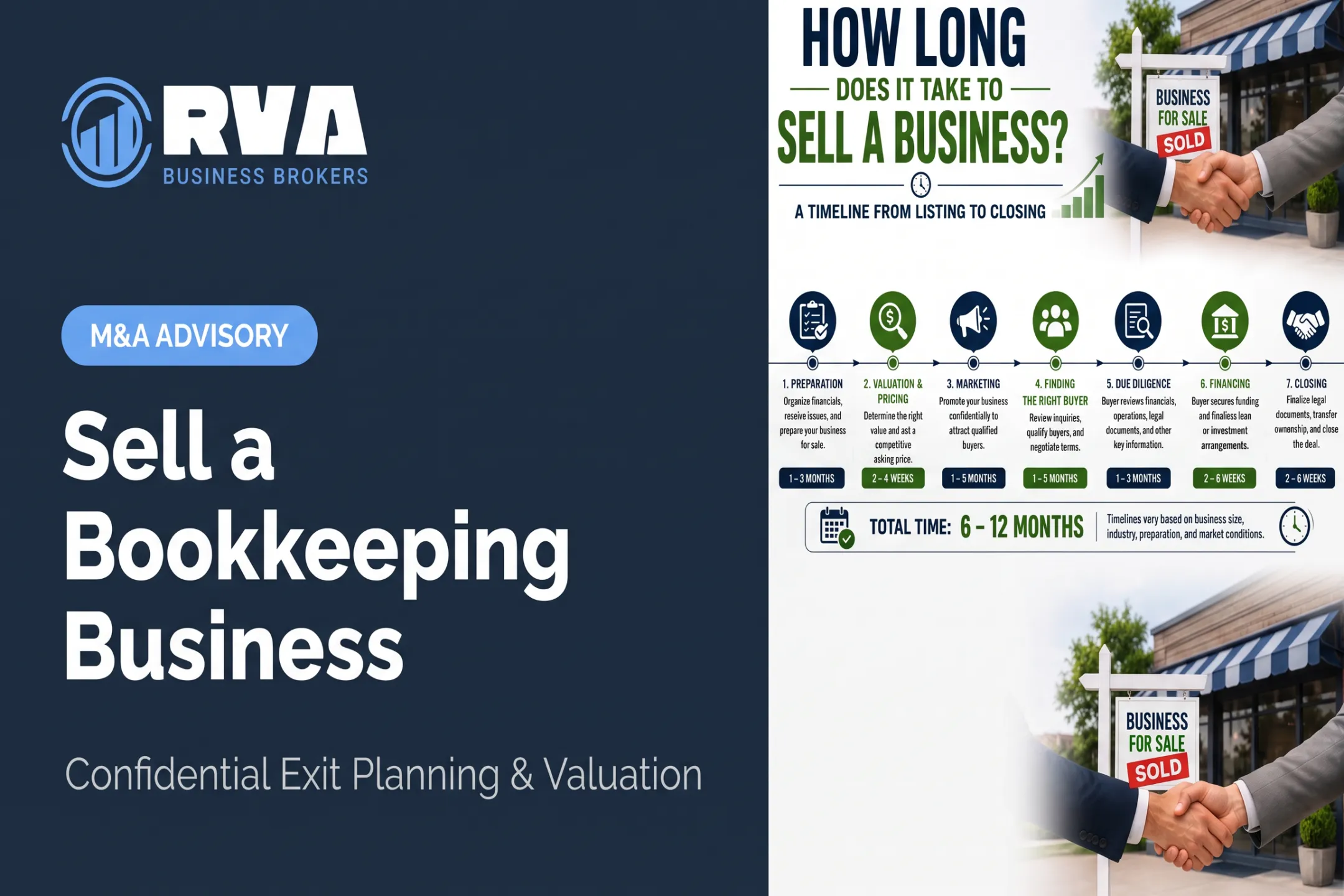
Most sales take 6 to 12 months from listing to close, depending on size, complexity, financing, and diligence. Preparation time beforehand can add weeks or months, depending on how much needs fixing first.
Should I sell my service business myself or hire a business broker?
A broker typically brings confidentiality, a qualified buyer pool, competitive tension, and negotiation experience that's hard to replicate alone. Selling directly saves on fees but shifts that workload and risk onto you.