
Many owners struggle with a basic question: what is my business actually worth? Annual revenue alone won't answer that. This guide walks through the valuation drivers buyers care about, the preparation work that strengthens your position, the decisions you'll face during the sale process, and the deal terms that determine what you actually walk away with.
Key Takeaways
- Recurring service agreements and replacement work make earnings more predictable, and buyers pay for predictability
- Clean, well-organized financials support a defensible valuation and speed up diligence
- Reducing owner dependency improves transferability, which directly affects price
- Early preparation, started before you list, creates more options and better outcomes
- Buyers evaluate normalized earnings, not revenue, so know the difference before you talk numbers
What Makes an HVAC Business More Valuable
Earnings Buyers Actually Pay For
Buyers don't value revenue. They value normalized earnings: what the business generates after adjusting for owner-specific or one-time items.
- Seller's Discretionary Earnings (SDE): Pretax profit plus owner compensation, benefits, and discretionary expenses. This is the standard metric for smaller, owner-operated HVAC companies.
- Adjusted EBITDA: Earnings before interest, taxes, depreciation, and amortization, after replacing the owner's duties with a market-rate cost for that labor. This metric fits companies with management depth that could run without the owner.
Which one applies depends on your size, structure, and the type of buyer you attract. A strategic buyer evaluating a $5 million HVAC platform will think in EBITDA terms; an individual buyer purchasing a $1.5 million owner-operated shop will think in SDE terms.
Recurring Revenue, Mix, and Concentration
Maintenance agreements, renewal trends, and service-call history show a buyer how much revenue repeats without new sales effort.
Capstone Partners' HVAC services M&A update notes that buyers favor maintenance-focused, repeat-customer revenue over one-off or seasonal work because it gives clearer visibility into future cash flow.
That doesn't mean every agreement adds the same value. Document your own renewal rate, cancellation trends, and attach rate rather than assuming a generic industry number applies to your shop.
Not all revenue carries equal weight in a valuation:
- Residential replacement and service work typically commands better margins and more predictability
- New-construction work tends to be lower-margin and dependent on builder relationships
- Heavy reliance on a handful of commercial contracts or a single builder raises perceived risk, even if revenue looks strong
Clean Financials and Operational Transferability
Buyers need to verify what you tell them. That means:
- Three or more years of tax returns and financial statements
- Documented owner add-backs with support
- Job costing and gross margin broken out by service line
- Reconciliation between your field-service software and your books
Beyond the numbers, buyers look hard at whether the business can run without you. Factors that cut transition risk and support a stronger price include:
- Capable operations or service manager
- Documented dispatch and sales processes
- Technician retention
- Current licensing and certifications
- Fleet condition and solid vendor relationships
Valuation ranges and multiples should come from comparable transactions, your normalized earnings, and your specific risk profile. They shouldn't be copied from another HVAC company's sale price or treated as guaranteed.

Prepare Your HVAC Business Before Listing
Preparation timelines vary. Owners selling within 12 months need to move fast on financial cleanup and documentation. Owners with one to three years of runway have time to actually build value, not just package what already exists.
Financial Cleanup Checklist
- Separate personal expenses from business expenses
- Document every add-back with support, not assumption
- Correct inconsistent revenue or expense classifications
- Track revenue and gross margin by service type (install, repair, maintenance)
- Reconcile tax returns with internal financial statements
- Prepare monthly trends that a buyer's accountant can independently verify
Build Recurring Revenue, Honestly
Review your maintenance-plan pricing, renewal process, and attach rates. Improve customer communication and service quality where it's lacking.
Avoid chasing an industry "benchmark" attach rate you've seen quoted online. No reliable national figure for maintenance-agreement renewal exists right now, so focus on your own trend line instead.
Reduce Owner Dependency
This is often the single biggest lever for value. Try this test: could your business run smoothly if you took a 30-day vacation with no contact? If not, start here:
- Delegate dispatch, estimating, and sales approvals to a manager
- Hand off vendor management and key customer relationships
- Document standard operating procedures for core workflows
- Actually test an extended absence before you list

Due-Diligence Readiness
Buyers typically request a full document package. Common items include:
- Contracts, leases, permits, insurance, and licenses
- EPA-related documentation, including Section 608 technician certifications
- Employee and payroll records
- Equipment and vehicle schedules plus warranties
- Litigation disclosures and supplier agreements
Building a secure data room now, rather than scrambling after an offer lands, keeps diligence moving and shows you run a tight operation.
Track the KPIs Buyers Will Ask About
A 2026 ACCA-affiliated survey of more than 1,000 HVACR contractors found an average service ticket of $422 ($390 residential, $516 commercial) and a 43% average installation close rate. That rate rose to 52% among contractors who presented multiple options to customers.
Use figures like these as context, not a target. Then track your own:
- Average ticket by job type
- Service agreement count and renewal trend
- Lead-to-booking and replacement close rates
- Technician productivity and call-back rate
- Gross margin and customer concentration
- Employee turnover
Decide Whether to Sell Independently or Use a Broker
Selling on your own means handling valuation, marketing, buyer screening, negotiation, financing coordination, and diligence yourself, on top of running your company. A broker or sell-side advisor takes on most of that workload and typically brings access to more qualified buyers and a structured negotiation process.
The Confidentiality Risk
Publicly signaling a sale creates real exposure:
- Employees may worry about job security and start looking elsewhere
- Customers may question continuity of service
- Competitors can use the news against you
- Vendors may tighten terms
Staged disclosure (using NDAs and withholding the company's identity until a buyer is qualified) protects you against all of this. That protection is a common reason owners work with a broker rather than listing openly.
When Professional Support Makes the Most Sense
Consider it if you:
- Have never gone through a business sale before
- Have multiple interested buyers and need to manage competing interest
- Operate under complex contracts, licenses, or commercial agreements
- Want to keep running the business instead of running the sale
- Need help comparing cash, seller financing, earn-outs, and rollover equity
Weighing the Fee
A broker's fee should be measured against what it buys: broader buyer reach, competitive bidding, confidentiality controls, and lower execution risk.
For a Richmond-area residential HVAC company generating $11 million in revenue, Mid Atlantic Business Brokers ran a confidential process that connected the owner with a national industry consolidator already expanding through acquisition. The sale retained roughly 30 employees and let the owner exit on his terms, relocating to Florida.
Mid Atlantic Business Brokers applies the same confidential marketing and buyer-qualification process to HVAC owners today. Valuations draw on USPAP and NACVA-aligned methods and Certified Business Appraisers, without promising any specific sale price or outcome.
Navigate the Sale Process and Deal Terms
The Stages of a Sale
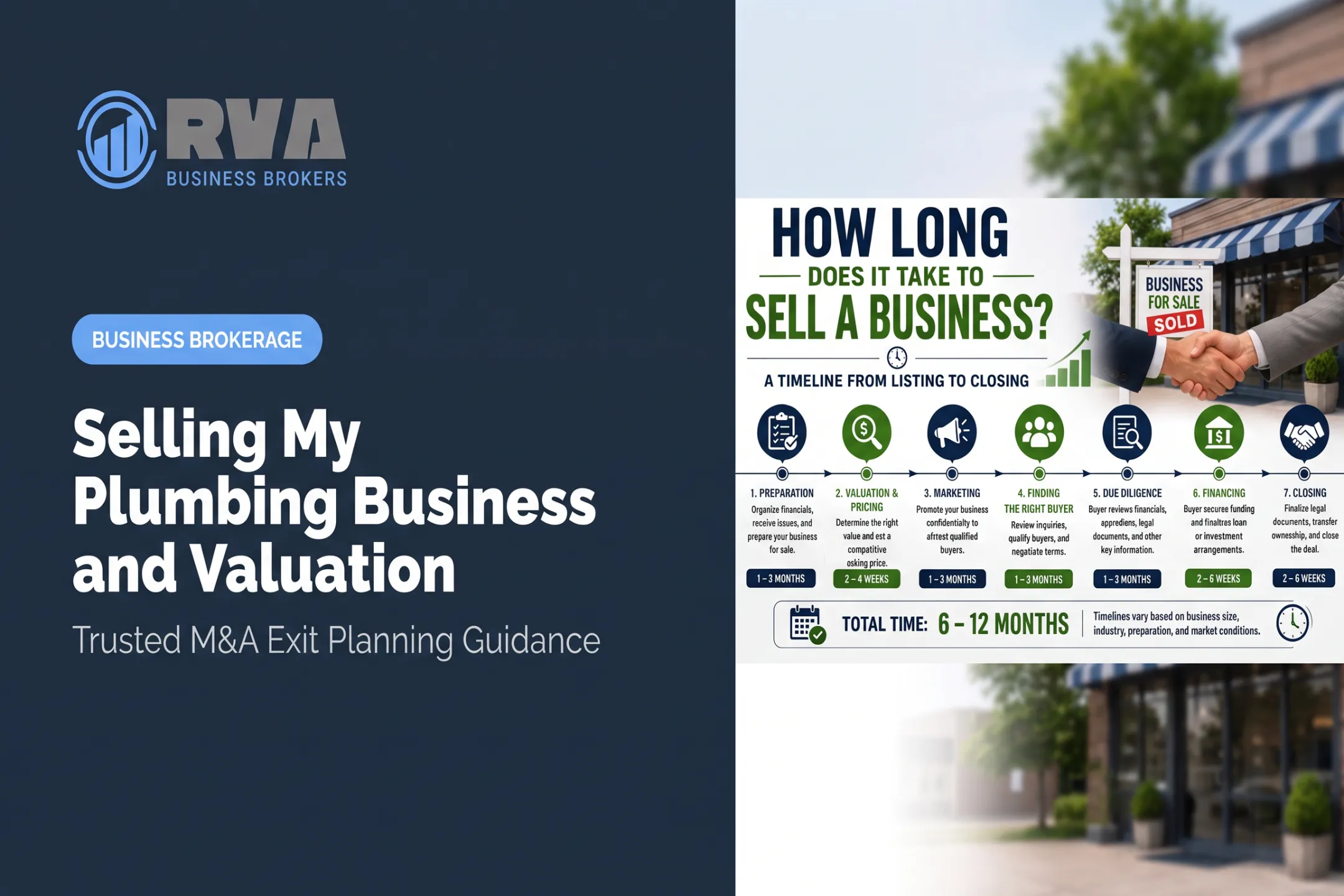
- Confidential valuation and preparation — establish earnings power and fix obvious gaps buyers will price against
- Buyer outreach — confidential marketing only to qualified prospects under NDA
- Indications of interest and LOI — exclusivity often runs 60–120 days after a letter of intent is signed
- Diligence — financial, legal, and operational verification of the HVAC business
- Definitive purchase agreement and closing
- Post-closing transition — training, introductions, and handoff of key relationships

Lower-middle-market deals often take 11–12 months from engagement to close, according to IBBA/M&A Source’s Market Pulse survey of brokers nationwide. Build a timeline that runs well past the LOI—diligence and definitive documents are where many HVAC deals slow down.
Know Your Buyer Type
- Individual owner-operators often value legacy, team continuity, and a clean handoff of routes and technicians
- Strategic HVAC or home-service companies look for market density, truck utilization, and operational synergies
- Private-equity-backed platforms prioritize recurring maintenance revenue and a model they can scale
- Other qualified investors may weigh cash-flow return alongside realistic growth potential
Deal-Structure Questions to Resolve
Buyer type shapes which terms show up first. Resolve these before you lean on a headline price:
| Term | What's at stake |
|---|---|
| Asset sale vs. equity/stock sale | Taxes you owe and which liabilities transfer |
| Cash at closing | How much is certain on day one |
| Seller financing / earn-outs | Payment timing risk vs. shared upside |
| Working-capital adjustments | Price changes tied to closing-date balance sheet |
| Escrow or holdback | Funds reserved for post-closing claims |
| Rollover equity | Ongoing exposure if you keep a stake |
Work through structure with transaction counsel and a tax professional—the right mix depends on your facts, not a template.
What Buyers Scrutinize in Diligence
Expect close review of:
- Earnings quality and add-backs behind reported cash flow
- Customer and revenue concentration (including key commercial accounts)
- Technician retention, pay structure, and key-person risk
- Licenses, insurance, and transferability of contracts
- Fleet/equipment condition and pending claims or compliance issues
Anything that doesn’t match your representations can reopen price talks—or delay closing.
Negotiate Beyond the Headline Number
A high asking price means little if the terms behind it are weak. Weigh:
- Payment certainty and timing
- Contingencies and personal guarantees
- Indemnification exposure
- Your required transition workload
- Any condition that lets a buyer reduce price before closing
Strong process discipline—clean data, controlled buyer contact, and clear term tradeoffs—matters as much as the multiple on the LOI. Mid Atlantic Business Brokers guides HVAC owners through these stages with confidentiality and structured negotiation support.
Decide Whether Now Is the Right Time to Sell
Timing comes down to two questions: are you personally ready, and is the business ready?
Personal readiness covers retirement, burnout, health concerns, a new chapter, or needing liquidity. Be honest about how long you'll stay through transition, especially if you still run estimates, trucks, or key accounts yourself.
Business readiness means stable earnings, real management depth, strong customer retention, and records that hold up under buyer scrutiny. HVAC buyers look closely at recurring maintenance contracts, technician retention, and how much revenue still depends on you.
Market conditions matter too, but they cut both ways. Buyer appetite, financing availability, and deal activity shift over time, so check current conditions rather than assuming the market always favors sellers.
If you're one to three years out, get a preliminary valuation and readiness assessment first. It tells you exactly what to fix before you list, whether that's profitability, recurring revenue, or management bench strength.
A simple framework:
- Sell now if the business is transferable and your personal goals require an exit
- Prepare first if fixable weaknesses are suppressing value
- Start confidential planning if you're genuinely unsure
Frequently Asked Questions
How do you value an HVAC business when selling?
Valuation starts with normalized earnings (SDE or adjusted EBITDA), not revenue. From there, buyers assess recurring revenue, owner dependency, customer concentration, team strength, and how your numbers compare to similar completed transactions.
How much is an HVAC business worth with $1,000,000 in annual sales?
Annual sales alone can't establish value. A credible number requires earnings, margins, revenue mix, recurring agreements, assets, liabilities, and how easily the business transfers to a new owner.
Are HVAC businesses profitable and what profit margins can I expect?
Profitability varies widely by service mix, pricing model, and overhead. A 2026 ACCA-affiliated survey of over 1,000 contractors found a 6% average net profit, well below the industry's commonly cited 10% target.
Is now a good time to sell my HVAC business?
It depends on your personal goals, how ready your business is, current buyer demand, and financing conditions. A confidential valuation and readiness review before listing is the best way to find out.