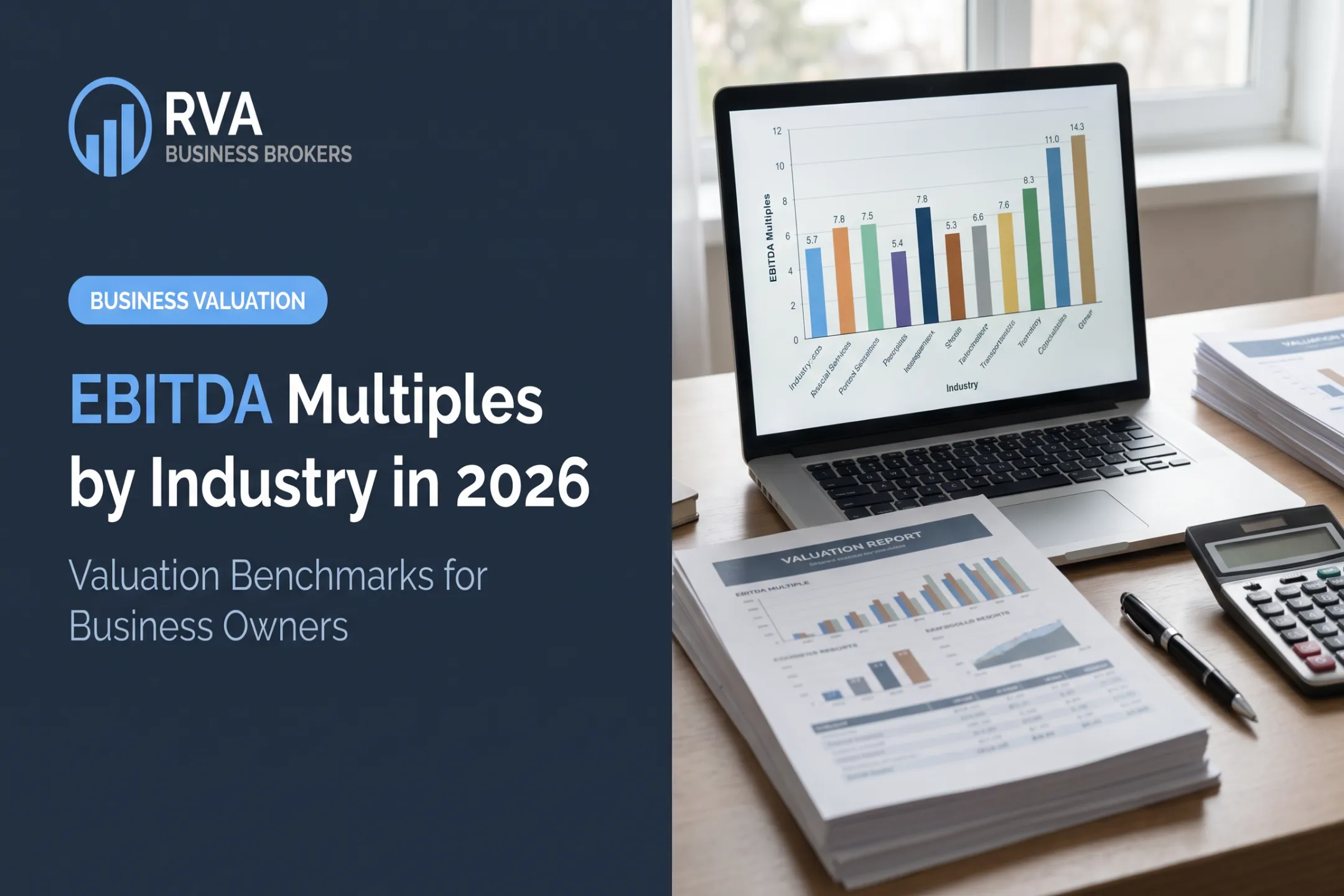

According to IBBA and M&A Source's Q4 2025 Market Pulse report, average purchase-price multiples ranged from 2.0x SDE for deals under $500,000 to 5.5x EBITDA for deals between $5 million and $50 million. That's not one multiple — it's a sliding scale shaped by size, earnings measure, and risk.
Before you apply any SDE, EBITDA, or revenue multiple to your own business, you need to understand your industry, your size tier, how dependent the company is on you, and how clean your financial story looks to a buyer. This article walks through what these multiples mean, why they vary, how to calculate one responsibly, and when it's time to bring in a professional instead.
Key Takeaways
- A multiple is only useful when paired with the right earnings measure: SDE, EBITDA, or normalized revenue.
- Industry averages are benchmarks, not promises; your specific risk profile determines where you land in the range.
- Recurring revenue, low customer concentration, and management depth all push multiples higher.
- Enterprise value isn't the same as your final check: debt, working capital, and deal structure all affect proceeds.
- Current, comparable transaction data beats an unsupported "industry figure" every time.
What Business Valuation Multiples Represent
A valuation multiple is a ratio: business value divided by a financial measure. Common formulas include:
- Enterprise Value ÷ EBITDA
- Business Value ÷ SDE
- Enterprise Value ÷ Revenue
The multiple itself reflects a buyer's expectations about future cash flow, risk, growth potential, transferability, and what else is available to buy right now.
Enterprise value isn't equity value. Enterprise value represents the whole operating business, debt and equity combined.
To get to what an owner actually walks away with, you subtract debt, add back surplus cash, and adjust for working capital against a negotiated target. That bridge matters more than most sellers expect.
Here's how the three core metrics differ:
| Metric | What it measures | Typically used for |
|---|---|---|
| SDE | Earnings before interest, taxes, depreciation, amortization, plus one owner's full compensation and benefits | Smaller, owner-operated businesses |
| EBITDA | Operating earnings before financing costs, taxes, and non-cash expenses — doesn't automatically add back owner pay | Larger or manager-run businesses |
| Revenue | Top-line sales, before any cost consideration | Early-stage or select industries, always alongside margin data |
Saying "it's a 4x business" tells you almost nothing on its own. Four times what? Historical or adjusted earnings? Does that produce enterprise value or equity value? Skip any of those details and the number is close to meaningless.
A quick illustration: Say a business generates $900,000 in normalized SDE, and comparable sales support a 2.8x multiple. That produces an indicative value of roughly $2,520,000. This is a hypothetical calculation meant to show the mechanics, not a market benchmark for any specific industry.
How Industry and Business Quality Influence the Multiple
Industry ranges give you a starting point, nothing more. They need to be matched to current transaction data for your size, revenue model, and profitability, not just your sector label.
Industry and Business-Model Differences
Software companies, healthcare practices, manufacturers, and restaurants all command different multiples because they differ in recurring revenue, capital intensity, regulation, and scalability. BizBuySell's full-year 2025 closed-transaction data shows just how wide that gap gets:
| Sector | Reported sales | Avg. price/cash flow | Avg. price/revenue |
|---|---|---|---|
| Software and app companies | 49 | 3.41x | 1.82x |
| Industrial/commercial machinery | 18 | 4.20x | 0.80x |
| HVAC businesses | 123 | 2.80x | 0.62x |
| Home health care | 92 | 2.84x | 0.60x |
| Medical practices | 139 | 2.58x | 0.70x |
| Restaurants | 1,774 | 2.26x | 0.37x |

Notice these are averages of closed sales, not asking prices, and they still vary by nearly 2x within the same data set. A small owner-operated HVAC company, a multi-location healthcare provider, and a technology firm shouldn't be compared just because they share a revenue figure.
Size matters too. An IBBA survey found average purchase-price multiples climbing from 2.0x SDE below $500,000 to 5.5x EBITDA between $5 million and $50 million. Part of that jump comes from switching earnings measures, not business quality alone.
Factors That Move a Business Up or Down the Range
Businesses move toward the higher end of their industry range when they show:
- Consistent profitability and stable or growing margins
- Recurring or repeat revenue with contracts in place
- Low customer concentration (no single client above 10-15% of revenue)
- Strong management that doesn't depend entirely on the owner
- Documented, repeatable processes
They slide toward the lower end when they show:
- Volatile earnings
- Weak financial records
- Aging equipment
- Regulatory risk
- Heavy reinvestment needs
Buyer type, financing conditions, and current M&A activity shift the range too.
Owner dependence is one of the clearest levers. Axial's June 2025 analysis of an HVAC sale described a company that installed an operational leader before going to market, attracted 375 recommended buyers, and closed within six months. That outcome shows how reducing owner dependence widens buyer interest, even without a disclosed multiple.
How to Calculate, Research, and Validate a Multiple
Treat any multiple you calculate as a preliminary estimate: a starting point for conversation, not a formal appraisal or negotiated price.
Prepare the Correct Financial Measure
Start by normalizing SDE, EBITDA, or revenue. That means:
- Adding back owner compensation beyond fair market replacement pay
- Removing one-time or personal expenses
- Keeping in costs a buyer will need to continue, such as software, maintenance, or a replacement manager's salary
Reconcile every adjustment to tax returns, financial statements, and payroll records. A buyer's advisor will test every add-back, so legitimate adjustments need paper trails.
Select Comparable Transactions
Look for deals matched by industry, size, profitability, geography, and growth rate—not just a generic "industry average."
A common screen drops deals older than five years and those more than tenfold larger or smaller in revenue or earnings. Treat that as a guideline, not a hard rule. Asking-price multiples also tend to run higher than closed-deal multiples.
Apply and Test the Multiple
The basic math: normalized SDE or EBITDA × a supportable multiple = indicative value. One number is not enough. Build a sensitivity table with a low, midpoint, and high multiple, then note what would move the business between those cases: stronger management, cleaner records, or more diversified customers, for example.

A full valuation often blends three approaches: asset-based, income-based, and market-based. Mid Atlantic Business Brokers conducts valuation work supported by USPAP and NACVA standards and applies all three methods so owners get a defensible figure rather than a single guess.
Validate the Result Before Relying on It
Before you use any multiple for an asking price or exit plan, review:
- Normalized earnings
- Working capital and capital expenditures
- Debt load
- Customer concentration
- Likely buyer financing
A confidential consultation can test your estimate against current market evidence and your goals. Mid Atlantic Business Brokers offers that review for owners exploring value one to three years before a sale.
Choosing Between SDE, EBITDA, Revenue, and Other Valuation Methods
The right metric depends on your business's size, how involved you are day to day, and who's likely to buy it.
SDE versus EBITDA
Match the metric to how the business actually runs:
- SDE: Owner-operated firms where you handle sales, operations, and client relationships. SDE captures the full benefit available to one owner-operator.
- EBITDA: Firms with a management team running daily operations.
Apply an EBITDA multiple to SDE (or vice versa) and you'll distort value significantly, sometimes by 50% or more. The two measures treat owner compensation completely differently.
Revenue Multiples
Revenue multiples help when earnings are temporarily depressed or when an industry commonly uses revenue-based comparisons. But revenue alone says nothing about margin.
That BizBuySell table from earlier shows software companies averaging 1.82x revenue while restaurants average just 0.37x. The gap is driven almost entirely by margin and recurring-revenue differences.

Never apply a revenue multiple without checking:
- Gross margin
- EBITDA margin
- Customer retention
- Capital needs
DCF and Other Approaches
Discounted cash flow (DCF) estimates the present value of expected future cash flows, rather than benchmarking against comparable sales. Market multiples ask, "What did similar businesses sell for?" DCF asks, "What will this specific business generate going forward?"
Valuation professionals often run both as a reasonableness check. If the two methods land far apart, that gap usually points to an assumption worth revisiting.
Implications and Common Misinterpretations
Falling outside a typical industry range doesn't automatically mean the benchmark is wrong. It can signal unusual strength, or a risk that needs a discount.
A few mistakes come up constantly:
- Multiplying revenue by an attractive industry figure without checking profitability, customer concentration, or capital expenditure needs.
- Treating a public-company multiple as directly applicable to a private business. Smaller private companies carry different liquidity and risk profiles than public ones.
- Assuming a headline multiple equals seller proceeds. Debt, cash, working-capital adjustments, earnouts, seller notes, escrow, and taxes all affect the final number.
Pepperdine's 2025 Private Capital Markets Report found business appraisers applying a median 15% discount for lack of marketability, plus a size premium averaging 5.50% at $1 million in company revenue versus 2.50% at $250 million.

Market conditions shift. Any published range should carry a date and get refreshed before you make an exit decision based on it.
Conclusion
Industry multiples are a useful starting point, not a substitute for analyzing your normalized earnings, business quality, and comparable transactions. The most defensible valuation connects the right financial metric with current market evidence and a clear explanation of why your business falls at a particular point in that range.
If you're planning a sale or just want to know where you stand one to three years out, Mid Atlantic Business Brokers offers a confidential, standards-based valuation and can identify specific improvements that may strengthen your valuation before you go to market.
Frequently Asked Questions
How do you value a business using multiples?
You normalize SDE, EBITDA, or revenue, then match comparable transactions by industry and size. Apply a supportable multiple to estimate enterprise value, and adjust for debt and cash to arrive at equity value.
What multiple of revenue is a business worth?
Revenue multiples vary widely by industry, margin, and growth rate: from under 0.4x for restaurants to over 1.8x for software companies. Don't use a generic figure without comparable transaction data for your specific sector.
What is a good EBITDA multiple?
No single figure fits every deal—industry, size, growth, management depth, and buyer type all move the range. Current comps matched to your situation matter far more than any fixed universal number.
What is the average EBITDA multiple for small businesses?
Small-business data is inconsistent because many smaller companies get valued on SDE instead. If you see a published range, check that it clearly defines the earnings measure and transaction date before relying on it.
What does a sales multiple mean?
A sales (or revenue) multiple is business value divided by annual revenue. It ignores profitability entirely, so margins, recurring revenue, and cash needs must be considered alongside it.
When should I use DCF vs valuation multiples?
DCF forecasts future cash flows and discounts them to present value; multiples benchmark against comparable sales. Using both together gives a stronger reasonableness check than relying on either alone.