
Introduction
Deciding to sell a business ranks among the biggest financial and personal decisions an owner will ever make. For most owners, that sale caps years of work, risk, and sacrifice.
Many owners struggle with timing and process. They list too quickly, or they say yes to the first buyer who calls. The strongest outcomes almost always come from preparation, not speed.
An "offer to sell" can mean several things: the decision to bring a business to market, the asking price and terms presented to buyers, or a proposal documented in a letter of intent (LOI). Each carries different implications.
This guide walks through business preparation, valuation, offer terms, confidentiality, negotiation, due diligence, and the steps required to reach closing, so you know what to expect before you commit to anything.
Key Takeaways
- A realistic valuation weighs financial performance, transferability, market evidence, assets, liabilities, and risk — not owner expectations alone
- The highest headline price isn't always the best offer once financing, contingencies, and taxes are factored in
- Controlled disclosure, buyer qualification, and a solid NDA protect sensitive business information
- Legal, tax, and accounting professionals should review any offer before you sign an LOI
What Does "Offer to Sell" Mean?
The term gets used loosely, but it describes several distinct stages of a business sale:
- Asking price: your stated price for the business, which may or may not include inventory or other assets. It's a marketing figure, not a guaranteed sale price.
- Buyer's offer to purchase: the buyer's proposed price, terms, and conditions, sometimes delivered directly as an LOI.
- Letter of intent (LOI): a preliminary roadmap covering price, structure, and the path to due diligence.
- Definitive purchase agreement: the legally enforceable document covering assets, payment, liabilities, representations, and remedies.
Sellers typically take one of two paths:
- Marketing the business proactively through a confidential process
- Responding to an unsolicited offer from a buyer who shows up uninvited
The second scenario deserves extra caution. An eager buyer with no competing bids has little incentive to offer fair value.
Is an Offer to Sell Binding?
Here's where many owners get tripped up. An LOI is typically non-binding on price and closing conditions. But certain provisions (confidentiality, exclusivity, access to information, and governing law) may still create real legal obligations even in an otherwise non-binding document.
The document itself must clearly state which sections bind and which don't. There's no universal rule. That's why legal review before signing matters, even for a "preliminary" letter of intent. Treat any offer as a starting point for evaluation and negotiation, not proof the deal is done.
How to Prepare Your Business Before Making an Offer to Sell
Preparation determines how smoothly and profitably a sale goes. Buyers notice gaps in records faster than owners expect.
Get Your Financial House in Order
Start organizing these documents well before you talk to any buyer:
- Three years of tax returns, at minimum
- Profit and loss statements and balance sheets
- Cash-flow records and debt schedules
- Payroll information
- Clear explanations for any unusual or non-recurring items
Reduce Owner Dependence
Buyers pay more for businesses that run without the owner glued to the desk. Document your operating procedures, clarify management responsibilities, and test whether the business can function without you.
One practical test: take a 30-day vacation. If operations stall without you, that's a red flag buyers will spot during diligence.
Address Operational Risk Factors
Buyers investigate more than the balance sheet. Expect scrutiny on:
- Customer concentration and supplier relationships
- Recurring revenue and contract terms
- Leases, licenses, and intellectual property
- Equipment condition and inventory accuracy
- Pending disputes or undisclosed liabilities
Fix what you can before marketing. Inconsistent records, unresolved legal matters, outdated agreements, or overreliance on a single customer or employee all slow deals down or lower offers.
Build a Realistic Timeline
Exit planning should account for your personal goals, business performance, tax planning, and the time buyers need to complete diligence.
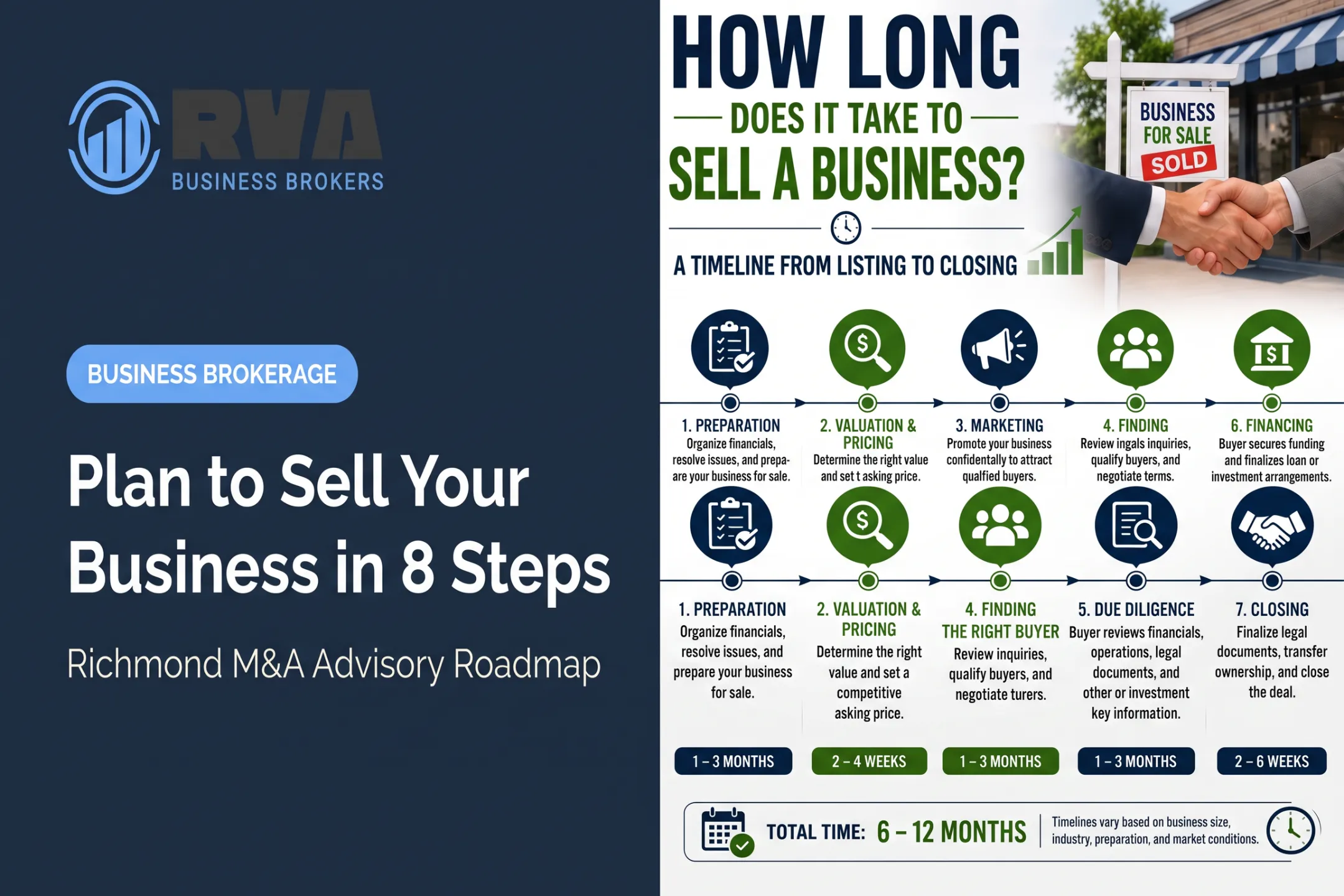
In a 2015 BizBuySell survey of over 500 owners and 300 brokers, 44% of owners expected a sale within five months, while 54% of brokers recommended allowing six to eleven months. That gap matters. Plan for the longer timeline, not the optimistic one.

Some Richmond-area owners begin working with an M&A advisor two to three years ahead of a planned exit, which gives time to fix problems before buyers ever see them.
How to Determine a Fair Asking Price and Deal Structure
Pricing a business correctly is where many sales succeed or fail before negotiations even start.
Three Valuation Approaches
| Approach | What It Measures | When It Fits Best |
|---|---|---|
| Asset-based | Assets minus liabilities | Asset-heavy businesses, liquidation scenarios |
| Income-based | Capitalized or discounted future earnings | Operating companies with stable cash flow |
| Market-based | Comparable sales of similar businesses | When solid comparable data exists |
A single revenue or profit multiple, applied without context, misleads more than it helps.
Is a Business Worth 3 Times Profit?
No. This is one of the most common myths sellers encounter, and it doesn't hold up against actual transaction data. Multiples vary by industry, how earnings are defined, growth trajectory, transferability, size, and risk.
Transaction data shows how wide the spread really is:
- IBBA/M&A Source Q4 2023 Market Pulse report: 4.0x EBITDA average for $2M–$5M deals; 5.3x for $5M–$50M (individual deals from 4.0x to 8.25x)
- BizBuySell 2025 year-end data: 2.61x cash flow average across reported small-business sales (a different measure entirely)

There's no "right" multiple. There's only the multiple your specific business supports.
Enterprise Value vs. What You Actually Pocket
Enterprise value isn't the same as the check you receive at closing. Equity value adjusts for debt, cash, and working capital.
Transaction fees, escrows, holdbacks, and taxes reduce it further. Seller financing or earnouts defer part of the payment to the future.
Deal structure elements that change your actual outcome:
- Cash at closing vs. seller financing or earnouts
- Escrow or holdback amounts
- Assumed liabilities
- Working-capital targets
- Asset sale vs. equity sale structure
- Non-compete obligations and transition services
A confidential business valuation establishes a defensible baseline before any of these negotiations begin.
At Mid Atlantic Business Brokers, valuation work applies asset-based, income-based, and market-based approaches aligned with USPAP and NACVA standards, led by Certified Business Appraisers. Valuation results are estimates, not guarantees. Your attorney and tax advisor should review any proposed structure before you agree to it.
What Should an Offer to Sell Include?
A complete offer or LOI should cover far more than just a price tag.
Core commercial terms:
- The business or specific assets being sold
- Proposed purchase price and payment method
- Closing date and included/excluded assets
- Assumed liabilities
- Real estate or lease arrangements
Payment structure needs careful specification as well. Seller financing, deferred consideration, earnouts, deposits, and escrow arrangements each carry different risks. A deferred payment is only as good as the buyer's ability and willingness to pay.
Conditions That Affect Whether a Deal Closes
Watch for these closing conditions in any offer:
- Buyer financing approval
- Landlord consent for lease assignment
- License or permit transfer
- Regulatory approval, if applicable
- Satisfactory completion of due diligence
- Key contract assignments
- Agreement on working-capital targets
Confidentiality and Exclusivity
Financial records, customer lists, and employee details shouldn't be disclosed until a qualified buyer has signed an NDA. Confidential marketing allows buyers to evaluate an opportunity without learning the business's identity upfront.
Exclusivity, or "no-shop," provisions limit your ability to talk to other buyers for a set period. Understand the duration before you agree. A long exclusivity window with a slow buyer can cost you other opportunities.
LOI vs. the Purchase Agreement
Treat the LOI as a framework, not the final contract. The definitive purchase agreement adds representations, warranties, indemnities, closing conditions, post-closing adjustments, and transition responsibilities that the LOI typically only outlines in broad strokes.
How the Business Sale Process Works After an Offer Is Accepted
Once an offer or LOI is signed, the real work begins.
What Happens After the LOI
The path from signed LOI to close usually looks like this:
- Due diligence
- Definitive agreement drafting
- Closing
- Post-sale transition
Due diligence typically runs 30 to 90 days, depending on complexity. In that window, buyers verify financial statements, tax filings, contracts, employee obligations, assets, liabilities, compliance records, and customer relationships.

When Buyers Try to Renegotiate
That same window is when price and terms often get tested. Sometimes buyers come back wanting a lower price or different terms. Legitimate adjustments stem from verified findings, such as an inventory shortfall or an undisclosed liability. Opportunistic renegotiation, where a buyer uses manufactured concerns to chip away at price, is different.
Sellers maintain leverage by:
- Continuing to operate the business normally
- Responding accurately and promptly to information requests
- Documenting every disclosure
- Meeting agreed deadlines
- Avoiding premature announcements to employees or customers
Mid Atlantic Business Brokers supports sellers through diligence, negotiation, deal structuring, lender introductions, vetted legal recommendations, and closing coordination, while representing the seller's interests exclusively.
Attorneys and tax professionals still handle the binding documents. A broker manages the commercial strategy and buyer communication around them.
Common Mistakes to Avoid When Offering Your Business for Sale
Sellers lose value in predictable, avoidable ways.
Pricing errors:
- Setting price based on emotional attachment or gross revenue alone
- Trusting a generic online calculator or an unsupported "3x profit" rule
- Ignoring market evidence and professional analysis
Confidentiality lapses:
- Sharing sensitive records before an NDA is signed
- Letting unqualified buyers access customer or employee details
- Announcing a sale before closing is reasonably certain
Disclosure failures:
- Hiding liabilities or overstating earnings
- Neglecting tax or legal issues
- Failing to disclose customer concentration or contract restrictions
Chasing the wrong number:
- Focusing only on headline price while ignoring cash certainty and financing risk
- Overlooking contingencies and tax treatment that shrink after-tax proceeds
- Accepting an offer that looks strong on paper but weakens at closing
Before signing an LOI or accepting binding terms, have a qualified business broker, transaction attorney, accountant, and tax advisor review the full picture. One rushed decision under time pressure, especially from an unsolicited buyer pushing for exclusivity, can cost far more than the delay of doing it right.
Frequently Asked Questions
What does "offer to sell" mean?
It can refer to the seller's asking price, a buyer's proposed purchase terms, a letter of intent (LOI), or occasionally the definitive purchase agreement. Context determines which one applies, so clarify before responding.
Can a seller go back on an accepted offer?
It depends on the document, which provisions are binding, applicable state law, and how far along the transaction is. Consult a transaction attorney before attempting to withdraw.
Is a business worth 3 times profit?
No universal multiple applies. Value depends on earnings quality, industry, size, growth, risk, transferability, assets, liabilities, and comparable sales data.
Is an offer to sell a business legally binding?
An initial offer or LOI may be non-binding in key respects, but provisions like confidentiality, exclusivity, or deposits can still create enforceable obligations.
What should be included in an offer to sell a business?
Expect price, payment terms, closing conditions, the due diligence period, confidentiality and exclusivity terms, assumed liabilities, working-capital targets, and transition requirements.
How do I know if an offer for my business is fair?
Get an independent valuation, compare the full deal structure (not just price), assess buyer certainty and financing, and review the offer with qualified legal, tax, and transaction professionals before responding.