
Introduction
If you've sat across the table from a buyer, lender, or valuation professional, you've probably heard the term EBITDA thrown around like it's gospel. It isn't cash in the bank. It isn't your final sale price. And treating it that way is one of the fastest ways to misprice a business.
EBITDA stands for earnings before interest, taxes, depreciation, and amortization. It strips out financing decisions and accounting choices so you can compare operating performance across businesses that look nothing alike on paper. Different debt loads, tax structures, and equipment-heavy balance sheets no longer distort that comparison.
This article breaks down what EBITDA actually measures, how to calculate it correctly, how adjusted EBITDA and market multiples factor into a valuation, and why multiplying one number by an assumed multiple is never the whole story.
Key Takeaways
- EBITDA measures operating performance, not total profitability, free cash flow, or what a seller actually walks away with
- Valuations often multiply adjusted EBITDA by a market multiple to estimate enterprise value
- Debt, cash, working capital, capital spending, taxes, and customer concentration must sit beside any EBITDA figure
- Normalizing the numbers and using defensible comparable data matters more than the formula itself
What Is EBITDA in Business Valuation?
EBITDA—Earnings Before Interest, Taxes, Depreciation, and Amortization—adds back four items to earnings: interest expense (and income), income taxes, depreciation, and amortization. Each add-back exists for a reason.
- Interest reflects financing choices, not operations. Two identical businesses can post very different net income if one carries heavy debt and the other carries none
- Taxes vary by entity structure and jurisdiction, so removing them lets you compare an S-corp to a C-corp fairly
- Depreciation and amortization are non-cash accounting allocations on tangible and intangible assets. Adding them back removes that allocation from the comparison; it does not mean the assets cost nothing to replace
How EBITDA Differs From Other Profit Measures
People use "profit" loosely, and that's where confusion creeps in. Here's how the terms actually stack up:
| Measure | What it shows |
|---|---|
| Gross profit | Revenue minus cost of goods sold, before operating expenses |
| Operating profit / EBIT | Profit after operating expenses, including depreciation and amortization |
| EBITDA | EBIT with depreciation and amortization added back |
| Net income | The bottom line, after interest, taxes, and everything else |
| Free cash flow | Actual cash generated after taxes and reinvestment needs |
EBITDA is a non-GAAP financial measure. Per the SEC's non-GAAP guidance, companies that disclose it should calculate it consistently and reconcile it clearly back to GAAP net income, not operating income, which isn't always the most comparable starting point.
For a privately held business headed toward a sale, that same discipline matters. Buyers and lenders want to see EBITDA calculated the same way, period after period.
How Do You Calculate EBITDA?
There are two formulas, and they should land on the same number when your books are classified consistently.
Formula 1 — starting from net income: EBITDA = Net income + interest expense + income taxes + depreciation + amortization
Formula 2 — starting from operating profit (EBIT): EBITDA = EBIT + depreciation + amortization
A Quick Worked Example
Say a company reports:
- Net income: $400,000
- Interest expense: $60,000
- Income taxes: $140,000
- Depreciation: $90,000
- Amortization: $10,000
Formula 1: $400,000 + $60,000 + $140,000 + $90,000 + $10,000 = $700,000 EBITDA
If that same company's EBIT (operating profit) is $600,000, Formula 2 gives $600,000 + $90,000 + $10,000 = $700,000 EBITDA. Same result.

If the two formulas don't reconcile, something is misclassified—usually nonoperating income or expense in the wrong bucket.
Where to Pull the Numbers
Calculate EBITDA from reliable records, not back-of-envelope guesses:
- Reviewed or compiled income statements (and balance sheets buyers will request alongside them)
- Three years of tax returns—most buyers treat this as the baseline package
- General ledgers and supporting schedules that tie out D&A, interest, and tax line items
Inconsistent bookkeeping (mixing cash- and accrual-basis entries, or burying personal expenses in operating accounts) distorts the result before you start adjusting it.
Calculate EBITDA monthly or quarterly, investigate any material swing, and document every adjustment. Buyers will ask for that trail in due diligence; clean support usually matters more than an aggressive add-back.
How Is EBITDA Used to Value a Business?
The basic market approach looks like this:
Estimated enterprise value = adjusted EBITDA × relevant EBITDA multiple
That's a starting indication, not an automatic price tag. The multiple isn't universal, and it shouldn't be pulled from a random online chart.
Enterprise Value vs. Equity Value
Enterprise value represents the operating business as a whole. Equity value (what the seller actually receives) requires a bridge:
- Start with enterprise value
- Subtract outstanding debt
- Add back cash on hand
- Adjust for agreed working-capital targets or other transaction-specific terms
This bridge should be verified with a valuation professional and transaction advisors, since purchase agreements often define these adjustments differently.
EV/EBITDA as a Ratio
EV/EBITDA simply divides enterprise value by EBITDA. It tells you how the market prices operating earnings — but only if the EBITDA period is clearly labeled as trailing, projected, or normalized. Mixing periods makes the ratio meaningless.
What Actually Moves the Multiple
Several factors push a multiple up or down:
- Industry and company size
- Revenue quality: recurring or contracted versus one-off
- Growth prospects and margin trends
- Customer concentration and management dependence
- Competitive position, asset needs, and perceived risk
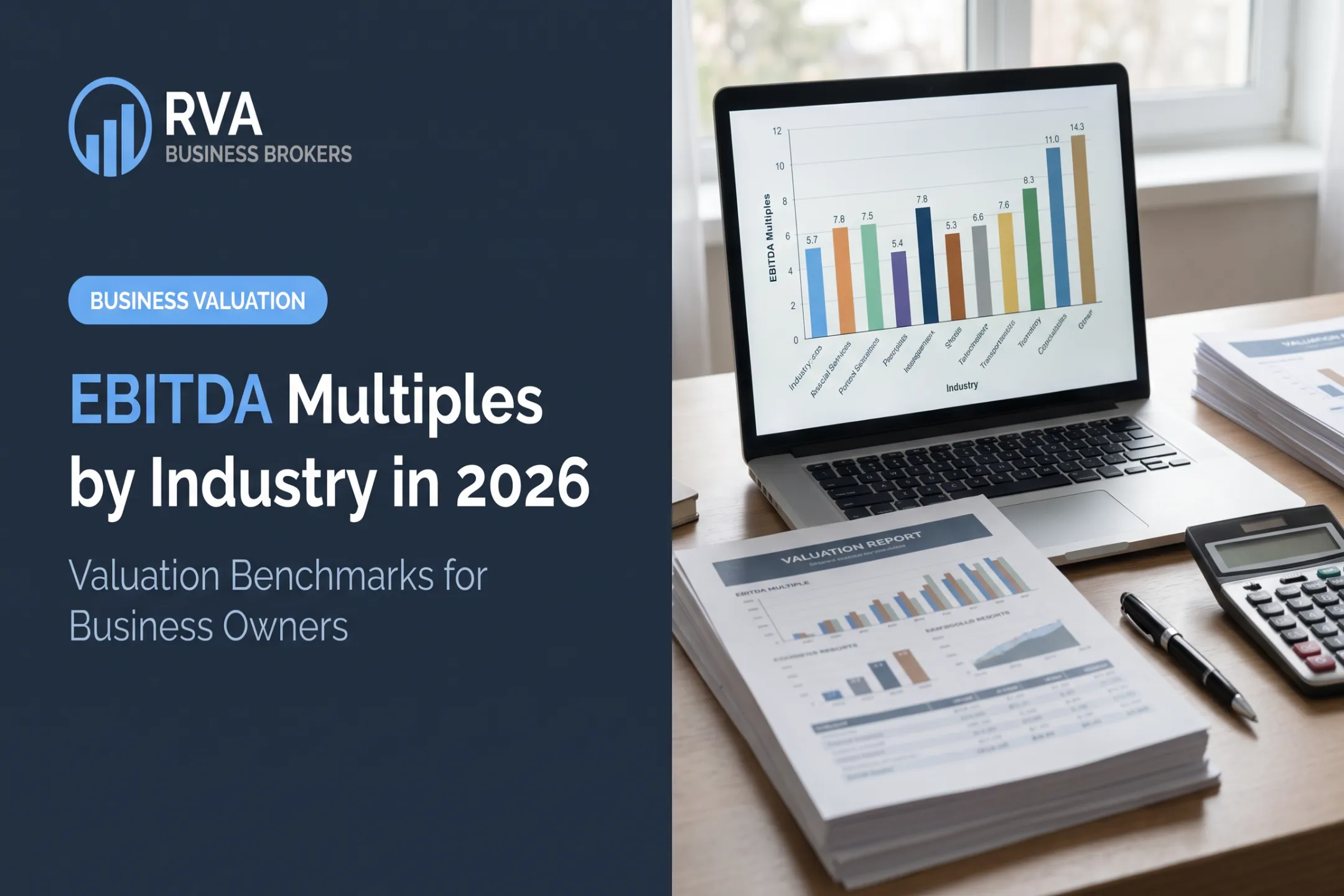
Pepperdine's 2025 Private Capital Markets Report illustrates just how much multiples vary by industry and EBITDA size band — not revenue:
| Industry | EBITDA under $1M | EBITDA $1M–$4.99M | EBITDA $5M–$9.99M |
|---|---|---|---|
| Manufacturing | 4.0x | 6.0x | 7.0x |
| Business services | 4.5x | 6.2x | 7.5x |
| Health care | 5.0x | 7.5x | 8.0x |
| Information technology | 5.5x | 7.0x | 6.0x |

Source: Pepperdine 2025 Private Capital Markets Report
Don't copy a public-company multiple or a generic industry average onto a private deal. Public markets price liquidity and scale that a $3M-EBITDA Richmond manufacturer simply doesn't have. You need current, relevant transaction comparables. Size, liquidity, data source, and business quality all affect how well those comps map to your business.
This is where a confidential, independent valuation earns its keep. Mid Atlantic Business Brokers builds valuations from financial statements, tax returns, cash flow, and market evidence. Those valuations apply asset-based, income-based, and market-based approaches grounded in USPAP and NACVA standards, not a single multiple pulled off a spreadsheet.
Adjusted EBITDA: What It Means and Why It Matters
Adjusted EBITDA (sometimes called normalized EBITDA) modifies reported EBITDA to reflect what the business would sustainably earn under new ownership. It is related to—but not the same as—seller's discretionary earnings (SDE). Adjustments should be documented, not assumed.
Common categories buyers expect to see explained:
- Owner compensation above or below fair market rate for a replacement manager
- Personal or discretionary expenses run through the business
- One-time legal, relocation, or litigation costs
- Nonrecurring revenue or unusual repair expenses
- Related-party rent that doesn't match market rates
- Expenses tied to assets or contracts the buyer won't continue
Unsupported add-backs damage credibility fast. A buyer's diligence team will strip out anything they can't verify, and that erodes trust in every other number you've presented.
EBITDA Margin — Useful, but Limited
EBITDA margin (EBITDA ÷ revenue) gives a quick efficiency snapshot, but there's no universal "good" number. DealStats' Q1 2025 report recorded aggregate acquired-private-company EBITDA margins moving from 18% in Q3 2024 to 16% in Q4 2024 — a market-wide trend, not a sector benchmark. Compare your margin against similarly sized peers in your industry, and track the trend over time.

Remember what EBITDA leaves out entirely:
- Capital expenditures
- Working-capital swings
- Financing costs
- Taxes
A business with heavy equipment needs can show strong EBITDA while still being a cash-flow drain. Pair this metric with real cash-flow analysis before drawing conclusions.
What Should Business Owners Review Before Using EBITDA in a Sale?
Before EBITDA becomes part of a pricing conversation, get your house in order.
Seller preparation checklist:
- Reconcile financial statements to tax returns for at least three years
- Separate personal and business expenses cleanly
- Document every proposed add-back with receipts or records
- Review owner compensation against market replacement cost
- Identify related-party transactions, including rent or vendor relationships
- Organize several years of financials in one accessible file
Buyers will stress-test your numbers during due diligence by looking at:
- Revenue concentration (no single customer should typically exceed 10–15% of revenue)
- Recurring versus one-time sales and customer retention
- Payroll, inventory, and accounts receivable trends
- Capital expenditure needs going forward
- Owner dependence: whether the business can run smoothly if you take a 30-day vacation
Virginia businesses with consistent profits and well-documented add-backs often command stronger offers, because buyers trust the numbers enough to pay full value for them.
If you're one to three years from a transition, don't wait until a buyer is at the table to find out what your EBITDA really supports.
Mid Atlantic Business Brokers provides confidential valuation and exit-planning guidance for owners across Richmond, Northern Virginia, Washington D.C., Maryland, the Carolinas, Georgia and Florida, without promising a number before the work is done. Reach out to start the conversation.
Frequently Asked Questions
What is a good EBITDA margin?
There's no universal benchmark — it depends on industry, business size, operating model, and stage. Compare your margin against similar peers and watch the trend rather than chasing a fixed percentage.
What is a good EBITDA multiple for valuation?
The right multiple depends on comparable transactions, industry, size, growth, recurring revenue, and risk. Never apply a public-company multiple directly to a private business.
How do I calculate the EV/EBITDA multiple for valuation?
Divide enterprise value by EBITDA, making sure both figures use consistent periods and definitions. This matters most when EBITDA has been adjusted or projected forward.
How do I value a company based on EBITDA?
Multiply adjusted EBITDA by a relevant market multiple to estimate enterprise value. Then adjust for debt, cash, and working capital, and cross-check the result with other valuation methods.
How much is a company worth based on EBITDA?
EBITDA alone can't tell you. You need sustainable EBITDA, relevant transaction evidence, company-specific risk factors, and the adjustments that bridge enterprise value to equity value.
What does EV/EBITDA tell you?
It shows how enterprise value compares to operating earnings before interest, taxes, depreciation, and amortization. The ratio is only meaningful when the businesses, periods, and EBITDA definitions being compared actually match.