
Introduction
A business doesn't sell well because a buyer showed up at the right moment. It sells well because the owner got ready long before that buyer ever called.
Readiness shapes everything: buyer confidence, your negotiating leverage, how long the deal takes, and what you walk away with after closing.
Yet many owners wait until they're emotionally ready to sell before doing any of the groundwork. That's a costly habit.
According to the Exit Planning Institute, only 20% to 30% of businesses that go to market actually sell.
Disorganized financials, heavy owner dependence, vague contracts, and unresolved compliance issues sink deals that should have closed.
This checklist walks through what actually improves your odds of closing: clarifying your goals, setting a defensible value range, cleaning up your books, strengthening operations, building a diligence file, protecting confidentiality, and assembling the right team.
Key Takeaways
- Start preparing one to three years before your target exit—even a shorter runway gains from focused prep
- Use valuation as a planning tool to guide fixes, not a guess from revenue alone
- Document how the business runs so it doesn't depend entirely on you
- Resolve financial and legal issues now, before a buyer finds them
- Build a coordinated team of legal, tax, accounting, and brokerage professionals
Clarify Your Exit Goals and Establish a Realistic Value Target
Know Why You're Selling
Your reason for exiting changes your entire strategy. Common drivers include:
- Retirement
- Burnout
- A new opportunity
- Health concerns
- A partnership dispute
- Planned succession
Each one points toward different timelines, buyer types, and deal terms.
A retiring owner might prioritize a clean break and immediate cash. Someone selling due to burnout might accept a longer transition if it means a faster exit from daily operations. Get specific about your "why" before you set terms, timelines, or a price target.
Rank Your Objectives
Write down what matters most, then rank it. Common priorities include:
- Total sale price and cash received at closing
- Payment structure (all cash versus seller financing)
- Length of post-sale transition or consulting role
- Employee retention and customer protection
- Speed of the sale process
- Legacy considerations, such as who takes over
Separate the non-negotiables from the "nice to haves." If price is flexible but a fast closing isn't, that shapes which buyers you'll pursue and what deal structures you'll consider.
Set a Target Date and Work Backward
Pick an exit date, then map milestones leading up to it: when financials need to be audit-ready, when owner-dependence issues should be resolved, when records need organizing, and when you'll engage advisors. Owners considering a sale within one to five years should start this planning now.
That backward calendar should also include when you’ll lock in a realistic value target—so pricing decisions aren’t left until you’re already in market.
Get an Objective Valuation
Before marketing the business, get a formal valuation. Three approaches typically apply, often in combination:
| Approach | What It Measures |
|---|---|
| Asset-based | Business value using assets net of liabilities |
| Income-based | Present value of anticipated future earnings |
| Market-based | Comparison to similar businesses that have sold |
At Mid Atlantic Business Brokers, valuations draw on these same asset-, income-, and market-based methods to produce a defensible benchmark, not a promised sale price. Buyer type, market conditions, financing availability, and diligence findings all influence the final number. Unrealistic seller expectations consistently rank as the top deal-killer, according to IBBA and M&A Source's Q1 2023 Market Pulse report.
Run a Readiness Check
Ask yourself:
- Could I step away for 30 days without the business suffering?
- Are earnings sustainable, or propped up by one-time factors?
- Would key customers stay after I leave?
- Could someone else learn to run this business from what's documented today?
If you hesitate on any of these, that's your starting point for preparation.

Clean Up Financials and Strengthen the Business's Value
Gather the Right Records
Buyers expect organized, complete documentation. Build a financial-records checklist covering:
- Income statements, balance sheets, and cash flow statements
- Three years of tax returns, at minimum
- Bank records and debt schedules
- Accounts receivable and payable reports
- Inventory records and payroll documentation
Larger or more complex deals may require additional years of records. Capstone Partners notes that buyers in M&A transactions often expect five to seven years of historical statements, plus several years of projections.
Normalize Your Numbers
Separate recurring operating performance from one-time expenses, owner perks, unusual income, and related-party transactions. Every add-back needs documentation, such as receipts, invoices, or payroll records. Buyers question add-backs line by line, and too many unsupported adjustments can kill a buyer's confidence fast.
Reconcile your tax filings against your internal books. Resolve discrepancies now. Review sales tax, payroll tax, and licensing obligations with your CPA before a buyer's accountant finds the gaps.
Once the books are clean, buyers still dig into:
- Revenue quality and gross margins
- Cash flow consistency
- Working capital needs
- Debt obligations and seasonality
- Reliability of your forecasts
Build Measurable Value
Focus on improvements that stick:
- Improve margins and cut avoidable costs
- Strengthen recurring or repeat revenue
- Diversify your customer base
- Tighten collections on receivables
- Address underperforming products or service lines
No single customer should represent more than 10-15% of total revenue. Heavy customer concentration, single-vendor dependence, volatile revenue, and unresolved debt or litigation all increase perceived buyer risk, usually resulting in lower offers or tougher terms.
One caution: don't make drastic changes solely to inflate short-term numbers. Buyers test whether improvements hold up after you're gone, and a sudden spike right before a sale raises red flags rather than confidence.
Make the Business Transferable and Build the Due Diligence File
Document How the Business Actually Runs
Buyers pay for an operating business, not a stack of past earnings. Document the workflows that keep it running: pricing, sales, fulfillment, purchasing, hiring, training, technology systems, and day-to-day decisions.
Reduce Owner Dependence
This is where many sales stall. Common red flags include:
- Customer relationships that exist only through you personally
- Institutional knowledge that lives in your head, not in writing
- Approval bottlenecks that require your sign-off
- Tasks no manager or employee can currently perform
The 30-day vacation test is a simple gauge here: could your business run smoothly if you disappeared for a month? If not, that's your priority list.
Review Your People
Owner dependence often shows up in the org chart next. Capture a clean people file before buyers ask:
- Roles, compensation, tenure, and benefits for every employee and manager
- Retention risks and anyone who is truly key-person dependent
In deals under $2 million, employee longevity and work ethic consistently rank among buyers' top due-diligence concerns, according to IBBA and M&A Source's Market Pulse data.
Inventory Assets and Obligations
List everything: equipment, vehicles, inventory, intellectual property, software, domains, leases, loans, insurance, permits, licenses, supplier agreements, and customer contracts.
Flag transferability questions for your attorney early, including:
- Change-of-control provisions in contracts or leases
- Landlord consent requirements
- Regulated-industry ownership restrictions
- Restrictive covenants or pending disputes
Build the Data Room
Once people, assets, and contracts are inventoried, assemble a secure diligence file. Include corporate documents, financials, tax filings, contracts, employee records, insurance, permits, and operational reports.
Then review the business as a buyer would and split issues into two lists: fix before marketing, or disclose and negotiate later.

Assemble the Sale Team, Protect Confidentiality, and Manage the Process
Know Who Does What
Selling a business well requires coordinated expertise:
- Business broker or sell-side advisor – pricing, marketing, buyer screening, negotiation
- Transaction attorney – contracts, liability, closing documents
- CPA or tax advisor – financial structuring, tax implications
- Valuation professional – defensible pricing analysis
- Wealth advisor – post-sale financial planning
- Lender – buyer financing, often through SBA 7(a) loans or traditional financing
Each advisor needs to understand your priorities and talk to the others. Disjointed advice slows deals down.
Choose a Broker Carefully
Look for:
- Relevant industry and transaction experience
- Valuation capability backed by recognized standards
- An active buyer network
- Clear confidentiality procedures
- Transparent fee structure
- References from completed, comparable deals
Protect Confidentiality
A well-run confidential sale uses staged disclosure:
- A brief, anonymous business profile goes to prospective buyers
- Interested buyers get qualified
- Buyers sign a non-disclosure agreement
- Access to detailed records opens gradually
- Meetings and site visits happen on a controlled timeline
Decide in advance who needs to know about a potential sale. Plan how you'll communicate with employees, customers, and vendors without disrupting daily operations.
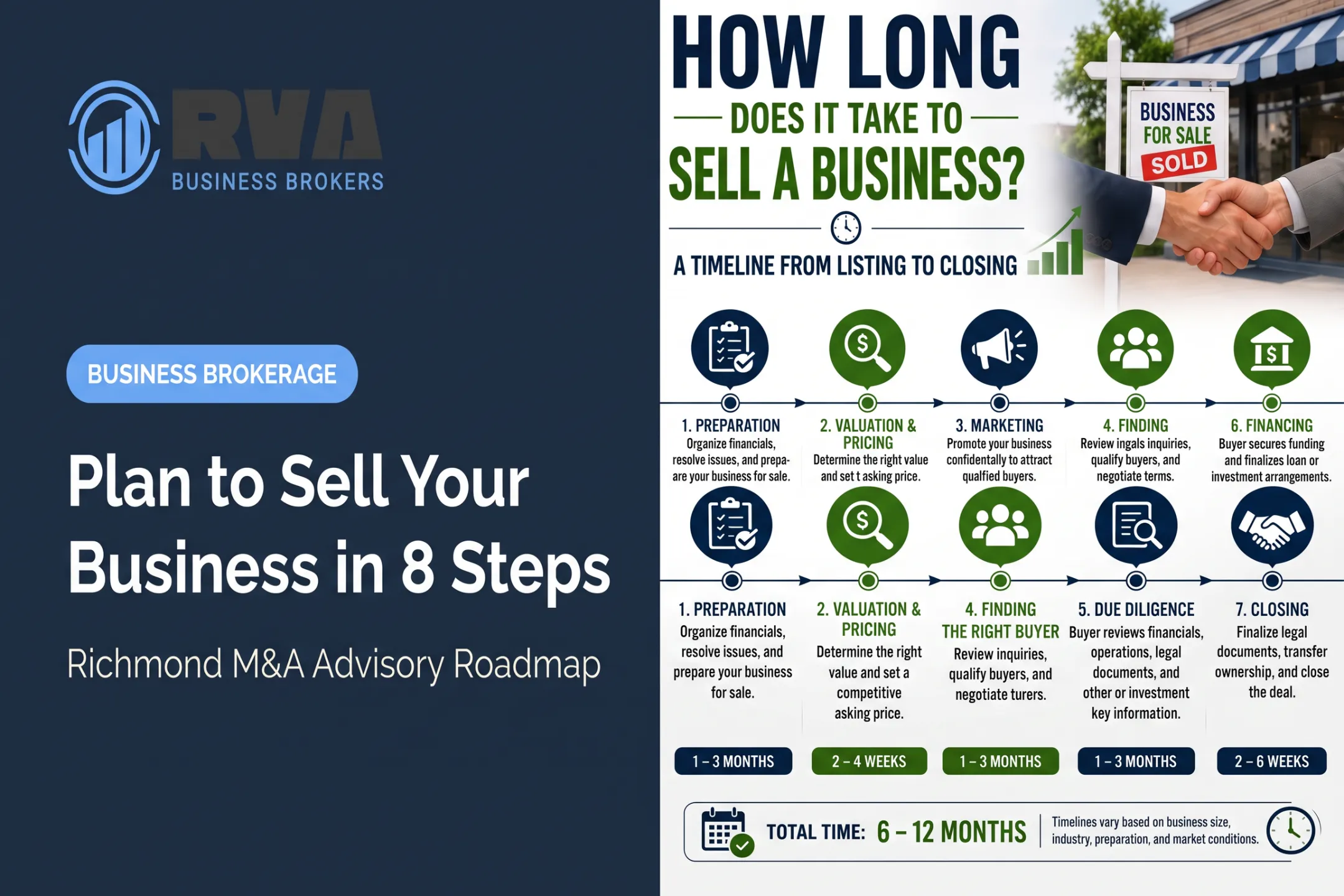
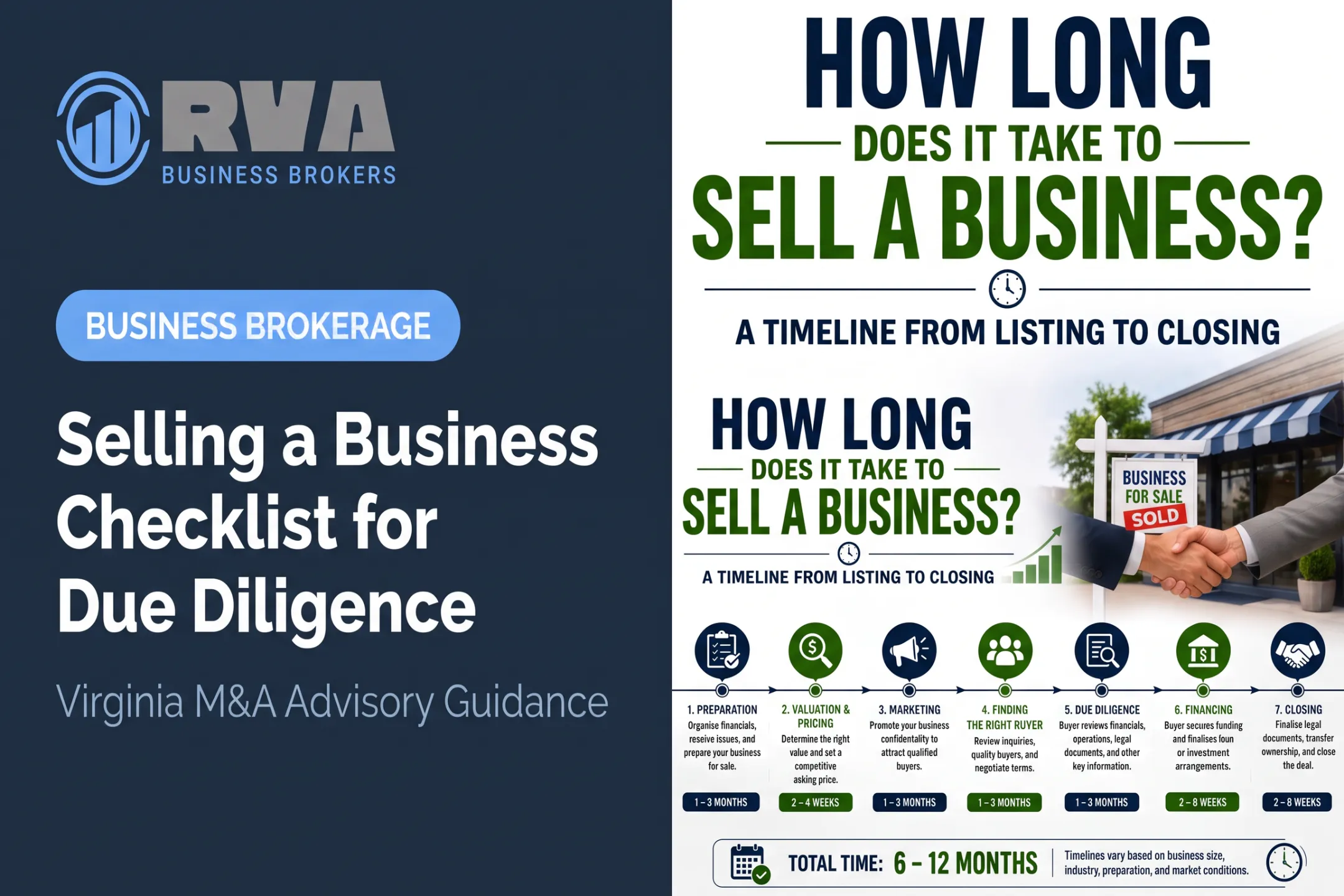
The Process, Start to Finish
Most sales move through these stages:
- Readiness assessment and valuation
- Confidential marketing
- Buyer qualification
- Indications of interest
- Letter of intent
- Due diligence
- Financing
- Definitive agreements
- Closing and transition
Most deals close in 6 to 12 months, though well-priced businesses in high-demand industries can move faster.
Mid Atlantic Business Brokers has guided owners across Virginia, Washington D.C., Maryland, the Carolinas, Georgia and Florida through that full arc for more than 40 years. Our team includes Certified Business Appraisers who apply USPAP- and NACVA-aligned methodologies.
We support valuation, confidential marketing, buyer sourcing, negotiation, deal structuring, and closing, and we represent sellers exclusively throughout.

This article is for general guidance only. Legal, tax, accounting, licensing, and investment decisions should be reviewed with appropriately qualified professionals before you act.
Frequently Asked Questions
How do I prepare my business to sell?
Clarify your exit objectives, get an objective valuation, and organize and normalize your financials. Reduce owner dependence, document operations, resolve legal or compliance gaps, protect confidentiality, and assemble an experienced advisory team before going to market.
How long does it take to sell a business?
Most sales close within 6 to 12 months, though larger or more complex businesses can take longer. A correctly priced business in a high-demand industry with strong marketing can sometimes sell in under six months.
What financial records do buyers want to see?
At minimum, expect to provide three years of tax returns, income statements, balance sheets, cash flow statements, and accounts receivable/payable reports. Larger transactions often call for five to seven years of history.
Can a broker guarantee a specific sale price?
No. A broker or valuation professional can provide a defensible value range based on financial performance, assets, and market comparables, but the final price depends on buyer type, financing, and negotiation.
What's the biggest mistake owners make when selling?
Waiting too long to prepare. Owners who go to market with unrealistic value expectations or disorganized financials often see deals stall or fall through in due diligence.